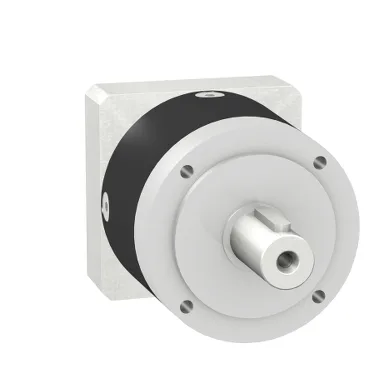
Obsolete — what that means for your BOM
The GBX0600151001F: If you need a drop-in replacement, you're looking at the same part through surplus, or a panel rework to a current-series gearbox.
Torque ratings — continuous vs peak
The continuous output torque is 44 N.m (389.4 lbf.in) at 100 rpm and 30 °C — this is the number to size against for steady-state conveyor or rotary indexing duty. Maximum output torque hits 70 N.m (619.6 lbf.in) under the same conditions, giving you about 60% headroom for acceleration peaks or momentary overloads. That 44 N.m continuous rating at 100 rpm means the gearbox delivers about 460 W output power at that speed. If your application runs faster or slower, the torque derates — the 30000-hour service life figure is tied to the 100 rpm, 30 °C condition.
15:1 reduction and what it buys you
A 15:1 ratio in a single planetary stage is a moderate reduction — it multiplies input torque by roughly 15× while dividing output speed by the same factor. For a typical 3000 rpm servo motor input, you'd get about 200 rpm at the output, right in the sweet spot for many indexing and positioning tables. The straight-tooth planetary design is simpler and more efficient than helical, but generates more audible whine under load. The 58 dB noise level at 1 m no-load is quiet enough for most machine-side environments — think packaging lines or light assembly, not a silent cleanroom.
Efficiency and thermal reality
94% efficiency means about 6% of the input power turns into heat inside the gearbox. At 44 N.m and 100 rpm (460 W output), that's roughly 29 W of heat to dissipate through the black anodized aluminium housing. The -25 to 90 °C ambient range covers both cold storage and hot machine environments. Lubricated for life — no oil changes, no maintenance schedule for the gearbox itself. The IP54 shaft output seal keeps dust and splash out of the bearings, but the housing itself isn't sealed against washdown; keep it out of direct hose spray.
Shaft loading — axial and radial limits
Maximum axial force is 450 N for the full 30000-hour service life, or 600 N if you accept a shorter 10000-hour life — both at 100 rpm and 30 °C. Radial force at mid-shaft is 340 N for 30000 hours, 500 N for 10000 hours. These are the limits that govern overhung load from a belt pulley or chain sprocket. The C45 steel output shaft is standard medium-carbon steel — hard enough for keyed or clamped couplings, but not case-hardened for high-wear applications like splined direct drives. If your coupling method involves set screws directly on the shaft, budget for surface marking.