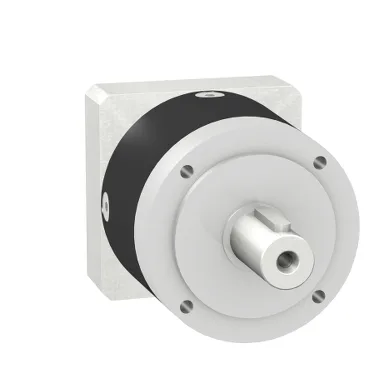
Lifecycle reality — obsolete, sourced through surplus
Schneider Electric has marked the GBX0600401001F as obsolete. This part is available through independent surplus and broker channels.
Torque and duty cycle — continuous vs peak
Continuous output torque is 40 N.m (354.03 lbf.in) at 100 rpm and 30 °C. Maximum output torque reaches 64 N.m (566.4 lbf.in) under the same conditions — that is the peak the gearbox can handle before the straight-tooth profile risks damage. Service life is rated at 30,000 hours at 100 rpm and 30 °C. The gearbox is lubricated for life, so no maintenance interval for grease changes.
Backlash and stiffness — positioning accuracy
Maximum torsional backlash is 20 arc.min. That is a standard-precision planetary — adequate for indexing and positioning where the load does not reverse direction under torque, but not for servo-grade zero-backlash applications. Torsional rigidity is 2.5 N.m/arcmin. This tells you how much the output shaft twists under load: at 40 N.m continuous, expect about 16 arcmin of windup before the gear teeth engage fully.
Shaft loading — axial and radial limits
Maximum axial force Fa is 450 N at 100 rpm for the 30,000-hour life target, or 600 N if you accept a 10,000-hour service life. Radial force Fr is 340 N at mid-shaft for 30,000 hours, or 500 N for 10,000 hours. These limits apply at 30 °C. Overhung loads from pulleys or sprockets must stay within the radial force envelope — exceeding it shortens bearing life faster than the torque rating suggests.
Environmental and mechanical specs
Shaft output seal is rated IP54 — splash-resistant but not submersible. Ambient operating range is -25 to 90 °C (-13 to 194 °F). Housing is black anodized aluminium, shaft material is C45 steel. Noise level is 55 dB at 1 m, no-load — typical for a straight-tooth planetary of this size. Efficiency is 94 %. The straight-tooth design is slightly less efficient than helical but simpler to back-drive in manual override situations.