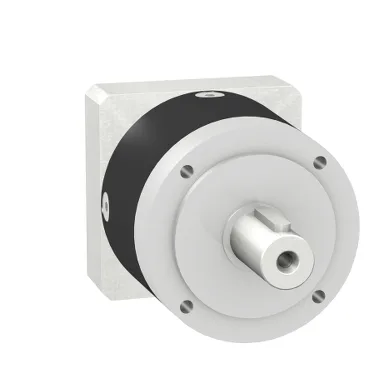
Planetary drive for precision indexing
The GBX0600400554F is a 60 mm-diameter planetary gearbox from Schneider Electric's GBX series, built with straight-cut teeth and a 40:1 reduction ratio — the kind of ratio that steps a servo's 3000 rpm down to 75 rpm at the output, provided the motor's continuous torque multiplied by 40 stays inside the 40 N.m continuous rating. It delivers 40 N.m continuous at 100 rpm and 30 °C, with a peak allowable of 64 N.m under the same conditions — the margin between continuous and maximum gives a 1.6× overload window for acceleration or intermittent jams, but the 30000-hour service life is quoted at the continuous figure, not the peak.
Torque, life, and the load limits that govern fit
The continuous output torque of 354.03 lbf.in (40 N.m) at 100 rpm and 86 °F (30 °C) is the number that decides whether this box survives in the application — run it above that continuously and the 30000-hour rated life starts compressing faster than a linear derating curve would suggest, because the lubricant film and bearing loads scale with the square of the torque. Maximum axial force Fa is 450 N at 100 rpm for the full 30000-hour life, stepping up to 600 N if you accept a 10000-hour service interval — the radial force Fr follows the same pattern at 340 N for 30000 hours and 500 N for 10000 hours, both measured at mid-distance on the output shaft, so an overhung load closer to the bearing face buys some margin. Torsional rigidity is 2.5 N.m/arcmin, which means the shaft twists one arc-minute for every 2.5 N.m of applied torque — in a positioning loop this stiffness sets the lower bound on the servo's ability to hold position under load; the 20 arc.min maximum backlash adds a fixed deadband on top of that windup, so the total lost motion at rated torque is the sum of both. Efficiency is listed at 94 % — the 6 % loss appears as heat inside the housing, and with a 60 mm black anodised aluminium body the thermal dissipation is limited by surface area; a continuous 40 N.m at 100 rpm is about 419 W mechanical input, of which roughly 25 W is lost as heat, which the housing can shed in free air provided ambient stays within the -25 to 90 °C operating range. Noise level is 55 dB at 1 m, no-load — that is quiet enough for a machine-tool environment but the figure is measured without load torque; under load the gear mesh whine will rise, especially with straight teeth, which produce more tonal content than helical gears at the same pitch line velocity.
Obsolete — sourcing through independent channels
For a BOM that needs this exact 40:1 ratio and 60 mm frame size, the GBX0600400554F remains the correct order code — the obsolete status means the procurement path is broker or surplus, not factory-direct, and the lead time depends on what lots surface at the time of the RFQ.
Integration notes for the panel builder
The shaft output carries an IP54 rating — that means it resists dust ingress and splashing water at the seal face, but the motor-side interface is not sealed; the gearbox mounts to the motor flange through the standard GBX pattern, and the whole assembly should be oriented so the breather path (if any) does not trap condensation. The housing is black anodised aluminium with a 60 mm external diameter — the anodised layer provides corrosion resistance but is not a structural coating; the C 45 steel output shaft is induction-hardened to take the radial and axial loads without brinelling the bearing seats over the 30000-hour life. Lubricated for life — no oil-change interval, no breather plug to vent, so the gearbox can be installed in any orientation provided the output shaft seal is not starved of lubricant; the life-of-box grease fill is calculated for the 30000-hour duty cycle at the rated torque and speed, so derating the load extends the service life beyond that figure.