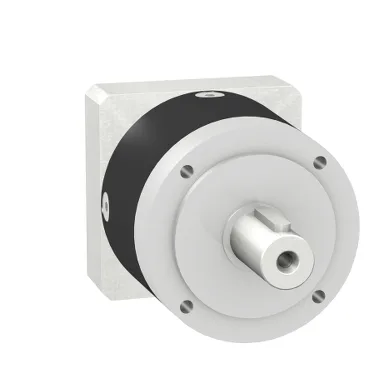
Torque delivery and duty cycle
The GBX0800030841D: Continuous output torque is 85 N.m, with a maximum output torque of 136 N.m — the 1.6× peak factor handles transient overloads like acceleration or momentary jams without oversizing the gearbox. The 3:1 reduction ratio in a single planetary stage keeps the efficiency at 96 %, meaning about 4 % of input power is lost as heat through the straight-tooth mesh. Service life is rated 30,000 hours at 100 rpm and 30 °C ambient — that's roughly 3.4 years of continuous 24/7 operation before the grease degradation or bearing wear reaches end-of-life. The gearbox is lubricated for life, so no maintenance interval for oil changes.
Mounting and environmental fit
The 80 mm outer diameter housing is black anodized aluminium; shaft material is C45 carbon steel. Any mounting position is acceptable, which simplifies integration into tight machine frames or vertical-axis applications. Shaft output sealing is IP54 — protected against dust ingress and splashing water from any direction. The gearbox body itself is not sealed to the same level; the IP rating applies specifically at the output shaft lip seal.
Backlash and rigidity — what the numbers mean for positioning
Maximum torsional backlash is 12 arc-minutes — that's the angular play between input and output when reversing direction. For a 3:1 reducer, 12 arc-min at the output corresponds to about 4 arc-min at the input side. This is standard for commercial planetary gearboxes; if your application needs precision indexing below 5 arc-min, you'd step up to a low-backlash or preloaded series. Torsional rigidity is 6 N.m/arcmin — the stiffness of the gear train under load. At the continuous torque of 85 N.m, expect about 14 arc-min of windup from the gear mesh alone, before any shaft deflection.
Shaft load capacities — axial and radial limits
Maximum axial force (Fa) is 1200 N at 100 rpm for a 10,000-hour life, dropping to 900 N for the full 30,000-hour rating. Radial force (Fr) at mid-span on the output shaft is 950 N for 10,000 hours, 650 N for 30,000 hours. These are the limits for belt-drive or direct-coupling loads — exceeding them shortens bearing life faster than the torque rating would suggest.
Noise and vibration profile
Noise level is 60 dB at 1 m, no-load — roughly the sound of a quiet office or a low-hum motor. Under load the noise will increase, but the straight-tooth planetary design is inherently quieter than a helical gearbox of equivalent size. Moment of inertia is 0.77 g·cm² reflected to the input — low enough that servo or stepper systems won't lose significant acceleration torque spinning the gearbox itself.