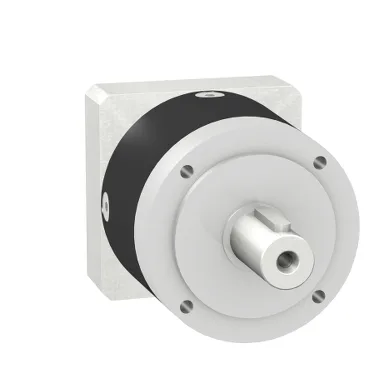
80 mm planetary stage — 3:1 reduction, 85 N.m continuous
The GBX0800030843D is a straight-tooth planetary gearbox in the 80 mm diameter frame, delivering a 3:1 reduction ratio with 85 N.m continuous output torque and a 136 N.m peak ceiling. Efficiency runs at 96 %, so the thermal loss through the stage stays low — useful when the gearbox is mounted in a confined cabinet or near heat-sensitive components. Noise measures 60 dB at 1 m under no-load, which is quiet enough for lab or light-assembly environments where operator exposure is a concern.
Continuous torque is 85 N.m; the maximum output torque of 136 N.m covers short-duration overloads like acceleration peaks or momentary jams without damaging the gear train. Service life is rated 30,000 hours at 100 rpm and 30 °C ambient — if your duty cycle runs faster or hotter, expect the life to shorten proportionally. The gearbox is lubricated for life, so no maintenance interval for oil changes. Maximum axial force (Fa) is 1200 N at 100 rpm for a 10,000-hour life, dropping to 900 N for the full 30,000-hour target. Radial force (Fr) follows the same pattern: 950 N for 10,000 hours, 650 N for 30,000 hours, both measured at mid-span on the output shaft. Torsional rigidity is 6 N.m/arcmin, and maximum backlash is 12 arcmin — the straight-tooth design trades some precision for higher torque density compared to helical stages.
Mounting, environment, and integration notes
The gearbox can be mounted in any position, which simplifies layout in tight machine frames or vertical-axis applications. Housing is black anodized aluminium; the shaft is C45 steel. Shaft output carries IP54 protection — fine for dry indoor use with occasional dust or splash, but not rated for washdown or outdoor exposure without additional sealing at the machine interface. Operating ambient range is -25 to 90 °C, covering most industrial enclosure environments without derating at the low end. Moment of inertia is 0.77 g·cm² reflected to the input — a low figure that won't dominate the servo tuning or acceleration budget in a typical motion axis.