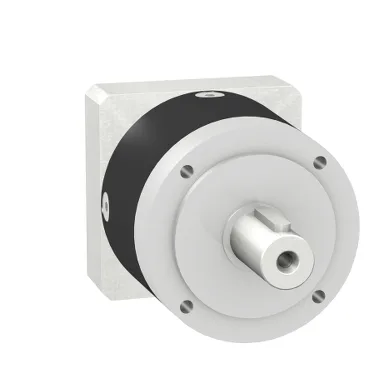
Planetary gearbox, 160 mm frame, 5:1 — now obsolete
The Schneider Electric GBX1600050702F is a planetary gearbox in the GBX series, 160 mm outer diameter, with straight spur teeth and a 5:1 reduction ratio. It delivers 450 N.m continuous output torque at 100 rpm and 30 °C, with a peak capability of 720 N.m under the same conditions.
Torque, backlash, and stiffness — the numbers that govern fit
Continuous torque is 450 N.m (3982.8 lbf.in) at 100 rpm and 30 °C; maximum output torque reaches 720 N.m (6372.5 lbf.in) at the same speed and temperature. The continuous figure is the one to size against for steady-state duty — the maximum covers transient overloads. Maximum torsional backlash is 6 arc.min, and torsional rigidity is 38 N.m/arcmin. Together they define the positioning repeatability under reversing loads — for indexing or servo applications, the 6 arc.min figure is the accuracy floor. Rated service life is 30,000 hours at 100 rpm and 30 °C with the continuous torque applied. The gearbox is lubricated for life — no oil-change interval, no fill port. That 30,000 h figure assumes the load and speed stay within the rated envelope.
Load limits on the output shaft — axial and radial
Maximum axial force Fa is 6000 N at 100 rpm for the 30,000-hour life target, or 8000 N if the application only needs 10,000 hours. Maximum radial force Fr is 4200 N at mid-span on the output shaft for 30,000 hours, or 6000 N for 10,000 hours. These are the bearing-life limits — overhung loads from pulleys or pinions must stay within these envelopes. The shaft is C45 steel, the housing is black anodized aluminium. Shaft output seal is IP54 — splash-resistant but not washdown-rated. Ambient operating range is -25 to 90 °C.
Efficiency and noise — energy loss and acoustic footprint
Efficiency is listed at 94 % — about 6 % of input power is lost as heat in the gear mesh and bearings. For a 450 N.m continuous output at 100 rpm (roughly 4.7 kW mechanical), expect around 280 W of thermal dissipation. The aluminium housing sheds that heat to ambient within the -25 to 90 °C range. Noise level is 70 dB at 1 m under no-load conditions. Straight spur teeth are inherently noisier than helical at higher speeds — the 70 dB figure is a reference for occupied-space installations.