Torque and duty cycle limits
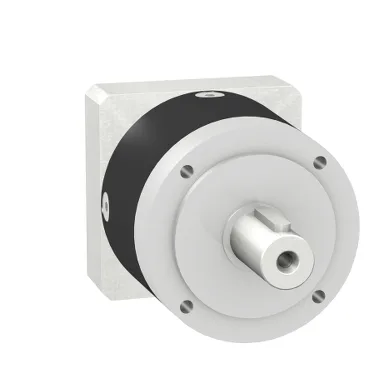
The GBX1600050703F: This is a planetary gearbox with straight teeth, 160 mm outer diameter, and a 5:1 reduction ratio. It delivers a continuous output torque of 450 N.m at 100 rpm, with a maximum intermittent torque of 720 N.m at the same speed — the 720 N.m figure is the peak the gearset can handle before overloading the tooth root, not a steady-state rating. Service life is rated 30,000 hours at 100 rpm and 30 °C ambient, with the gearbox lubricated for life — no oil changes, no breather. The IP54 shaft output seal keeps dust and splash out, but the housing itself is black anodised aluminium; it's not rated for washdown or submersion.
Load capacity and stiffness
Maximum axial force on the output shaft is 6000 N for the full 30,000-hour life, or 8000 N if you accept a shorter 10,000-hour service window. Radial force limits follow the same pattern: 4200 N at mid-span for 30,000 hours, 6000 N for 10,000 hours. These are the limits that govern bearing life, not the gear mesh. Torsional rigidity is 38 N.m/arcmin — that's the stiffness of the output shaft and gear train under load. Combined with a maximum backlash of 6 arc.min, this gearbox suits positioning applications where repeatable stop accuracy matters more than absolute zero-backlash. Efficiency is 94 % at rated load, which is typical for a single-stage planetary with straight teeth. Noise level is 70 dB at 1 m, no-load — the straight-tooth mesh generates more whine than helical, but the aluminium housing damps some of it.
Lifecycle and sourcing — obsolete, sourced to order
Schneider Electric lists this part as obsolete. The gearbox is available through independent surplus and broker channels — quantities are confirmed at RFQ, and the price and lead time vary with the lot. The spec table carries the full set of ratings: continuous torque 450 N.m, maximum torque 720 N.m, axial and radial load limits, backlash, rigidity, and temperature range -25 to 90 °C. These are the numbers to match against your existing BOM line before committing.