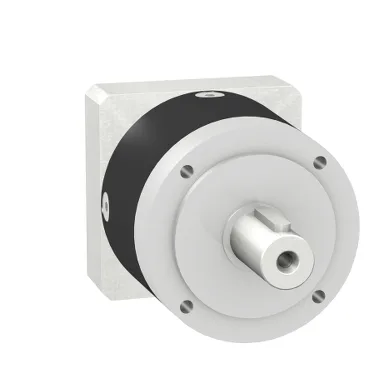
Planetary gearbox for servo-driven axes
The GBX1600150701F is a straight-tooth planetary gearbox from Schneider Electric's GBX series, sized for servo motor output stages where compact torque multiplication is needed — think indexing tables, pick-and-place gantries, or rotary axes on a packaging or assembly machine. With a 15:1 reduction ratio and 700 N.m continuous output torque at 100 rpm, it matches the duty cycle of a moderate-load servo axis running at moderate speed — not a high-speed spindle, but a positioning axis where stiffness and repeatability matter.
Torque, stiffness, and backlash — the real selection numbers
Continuous output torque is 700 N.m at 100 rpm and 30 °C; the maximum intermittent peak is 1120 N.m at the same speed — the buyer's load profile must stay under the continuous figure for thermal stability, with peaks only during acceleration or emergency stops. Torsional rigidity is 41 N.m/arcmin — this tells you how much the output shaft twists under load. For a positioning axis, a stiffer gearbox means less lost motion between the motor encoder and the load; 41 N.m/arcmin is typical for a 160 mm-frame planetary. Maximum torsional backlash is 10 arc.min — that is the angular play at the output when reversing direction. For single-direction continuous rotation it is irrelevant; for a reversing servo axis (like a gantry or rotary table), 10 arc.min is a standard precision grade, not low-backlash.
Mechanical limits that govern the installation
Maximum axial force Fa is 6000 N at 100 rpm for the 30000-hour service life, or 8000 N if the application only needs 10000 hours — the bearing life is the limiting factor, not the shaft. Radial force Fr is 4200 N at mid-span for 30000 hours, 6000 N for 10000 hours. The black anodized aluminium housing is IP54 at the shaft output — meaning it resists dust ingress and splashing water, but is not rated for washdown or submersion. The gearbox is lubricated for life, so no oil-change schedule. Service life is 30000 hours at rated torque and speed — that is about 3.4 years of continuous 24/7 operation.