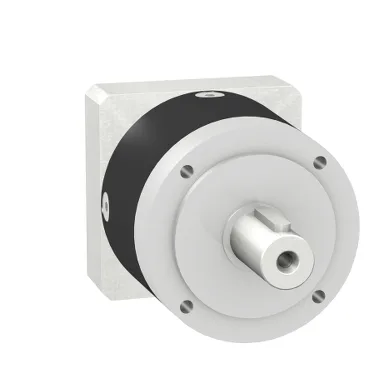
The GBX1600150551F: The 15:1 reduction ratio means the input speed is divided by 15 while torque is multiplied by roughly the same factor minus efficiency losses — this is the primary selection parameter for matching motor speed to load RPM. Continuous output torque is 700 N.m at 100 rpm, with a maximum intermittent torque of 1120 N.m at the same speed — the continuous figure governs duty cycle sizing; the maximum covers startup and short overloads. Torsional rigidity of 41 N.m/arcmin and maximum backlash of 10 arc.min define positioning repeatability — for indexing or servo applications, the backlash figure is the one that determines whether the gearbox meets the accuracy budget.
Load limits and service life — what 30,000 hours buys you
Rated service life is 30,000 hours at 100 rpm and 30 °C — this is the L10 bearing life under rated load, not a hard failure point. The gearbox is lubricated for life, so no maintenance interval for oil changes. Maximum axial force Fa is 6000 N for the 30,000-hour life, or 8000 N if you accept 10,000-hour life. Radial force Fr follows the same pattern: 4200 N for 30,000 hours, 6000 N for 10,000 hours, with force applied mid-shaft. These are the limits for overhung loads like pulleys or sprockets. Efficiency is 94 % — about 6 % of input power is lost as heat. Noise level is 70 dB at 1 m, no-load, which is typical for a straight-tooth planetary of this size; expect a few dB higher under full load.
Sourcing an obsolete planetary — what to expect
The 160 mm diameter housing is black anodized aluminium with shaft output IP54 protection — the IP rating means it resists dust ingress and splashing water but is not rated for washdown. Shaft material is C45 steel. Available through independent surplus channels — quantities are lot-specific and confirmed at RFQ. No direct drop-in replacement from Schneider's current catalog has been identified; a functional replacement would need matching the 160 mm frame, 15:1 ratio, and 700 N.m continuous torque.