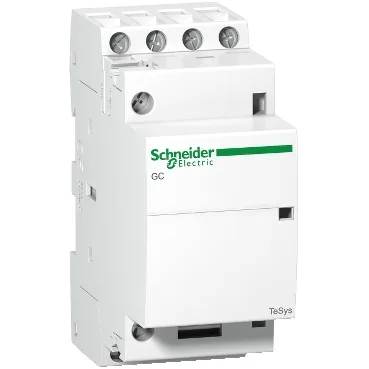
The Schneider Electric GC2522F5 is a TeSys GC modular contactor, a 4-pole device with a 110 V AC 50 Hz control coil, rated for switching loads in heating, motor control, and lighting applications under utilisation categories AC-7A and AC-7B. The contactor is supplied as a set of 6 units, which simplifies ordering for multi-circuit panels or line replacements where you need a batch of identical contactors.
The control coil is rated 110 V AC at 50 Hz, with an operating range of 0.85 to 1.1 Uc at 50 Hz (below 50 °C) and a drop-out threshold of 0.2 to 0.75 Uc — so the contactor drops out reliably when control voltage sags below about 22 V, which matters for brownout ride-through in industrial lines. Rated breaking capacity is 68 A at 400 V for the power circuit per IEC 61095, and making capacity is the same 68 A at 400 V AC — this tells you the contactor can interrupt and establish motor inrush currents up to that level, not just carry the steady-state load. Electrical durability is rated at 100,000 cycles for both AC-7A and AC-7B categories, with mechanical durability at 1,000,000 cycles — the electrical rating is the one that governs replacement intervals in frequent-switching applications like lighting or small motor control. Heat dissipation is 1.6 W at 50/60 Hz, or 1.6 W per pole — low enough that thermal buildup in a crowded DIN-rail enclosure is manageable, but worth checking if you pack multiple units side by side in a sealed box. The power circuit is rated for an associated fuse of 25 A gL at up to 440 V — this is the maximum fuse size for short-circuit protection; the contactor itself is not a circuit breaker and relies on upstream protection. Operating time is 10 to 25 ms for opening and 10 to 30 ms for closing — fast enough for most switching duties, but if you need coordinated timing with other devices in a sequence, account for the spread.
Screw clamp terminals on both control and power circuits, with a tightening torque of 0.8 N.m for both. Power circuit accepts up to 6 mm² solid or flexible (without ferrule) or 2 x 4 mm² flexible without ferrule; control circuit accepts up to 2.5 mm². Strip length and ferrule use follow standard practice for this terminal class. IP20 protection per VDE 0106 (fingerguard) when mounted in an enclosure rated IP40 — so the contactor itself is not sealed against dust or moisture; it needs a cabinet for washdown or outdoor environments. Rated insulation voltage is 500 V per IEC 61095 and VDE 0110, and operating altitude is up to 3000 m — fine for most industrial sites, but if you are at high altitude, the dielectric strength derates above 2000 m and you may need to consider that.
Mechanical robustness and operating limits
Withstands shocks of 10 Gn for 11 ms when open and 15 Gn for 11 ms when closed, plus vibrations of 2 Gn at 5–300 Hz open and 3 Gn at 5–300 Hz closed — this is a contactor that holds in on a vibrating conveyor or pump skid, but verify against your specific vibration profile if it is mounted near a large reciprocating compressor. Maximum operating rate is 300 cycles per hour at 50 °C — so about one operation every 12 seconds continuous. If your application cycles faster than that, you need a contactor rated for higher switching frequency. Average impedance of the power circuit is 2.5 mOhm at Ith 25 A, 50 Hz — low enough that voltage drop across the contacts is negligible for most loads, but if you are switching very low voltages or high-precision loads, factor it in.
It complies with IEC 60947-5 and IEC 61095 — the relevant standards for control circuit devices and contactors for household and similar purposes — so it carries the CE mark for European markets and is accepted in most industrial jurisdictions that adopt these IEC standards. The protective treatment is TC (tropical coating), which means it has some resistance to humidity and mild corrosive atmospheres — not a full conformal coating, but better than untreated for storage or installation in non-conditioned spaces.