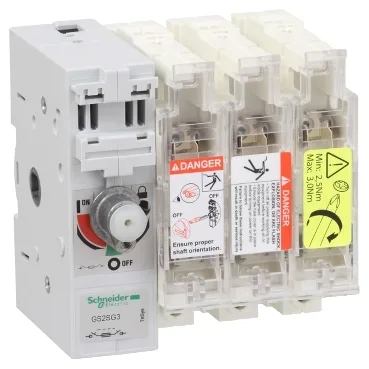
The GS2SG3 is a TeSys GS switch-disconnector-fuse, 3-pole, rated for 630 A at 400 V in AC-23B duty — that's the heavy motor switching category per IEC 60947-3, so it handles starting surges and load-break on induction motors up to that current without welding the contacts. It accepts DIN fuse-links size 3, three protected poles (3t), and mounts to a plate — no DIN-rail clip, so budget for a backplate or enclosure sub-panel. Rated operational power runs to 355 kW at 400 V and 400 kW at 690 V, making this a main incoming or large motor feeder switch for industrial panels up to that load class.
Breaking capacity is 5040 A at 400 V (AC-23B), and making capacity hits 6300 A at the same voltage — that's the fault-closing capability, so it can be closed onto a bolted fault without exploding the switch. Short-circuit withstand is 70 kA, backed by an 80 kA rated short-circuit making capacity (Icm) when protected by gG fuses — the fuses do the interrupting, but the switch must survive the let-through until they clear. Rated insulation voltage is 1000 V AC, impulse withstand 12 kV — fine for 690 V line-to-line systems and gives headroom for transient-heavy environments like VFD line reactors or welding supplies.
Plate-mount only — the external left-side operating handle means it's designed for enclosure-door interlocking, not standalone DIN-rail use. Factor in the handle cut-out and door interlock bracket. Power terminals accept bars up to 63 mm² or ring lugs for two cables up to 300 mm² each — big enough for paralleled feeders. Tightening torque is 44 N.m on the power circuit, so a decent torque wrench is needed.
Durability and compliance
Mechanical durability is 8000 cycles — that's the handle-to-contact mechanism life. Electrical durability is 1000 cycles at AC-23A or AC-23B, and 200 cycles at DC-23A or DC-23B. For frequent switching (e.g., a welding station or a cyclic conveyor), those electrical cycles go fast — plan for a contactor instead if you need hundreds of operations per shift. Fire resistance: the fuse cover withstands 850 °C, the body 960 °C per IEC 60695-2-1 — that's glow-wire tested for flammability, relevant for CE-marked panels and machinery directives.