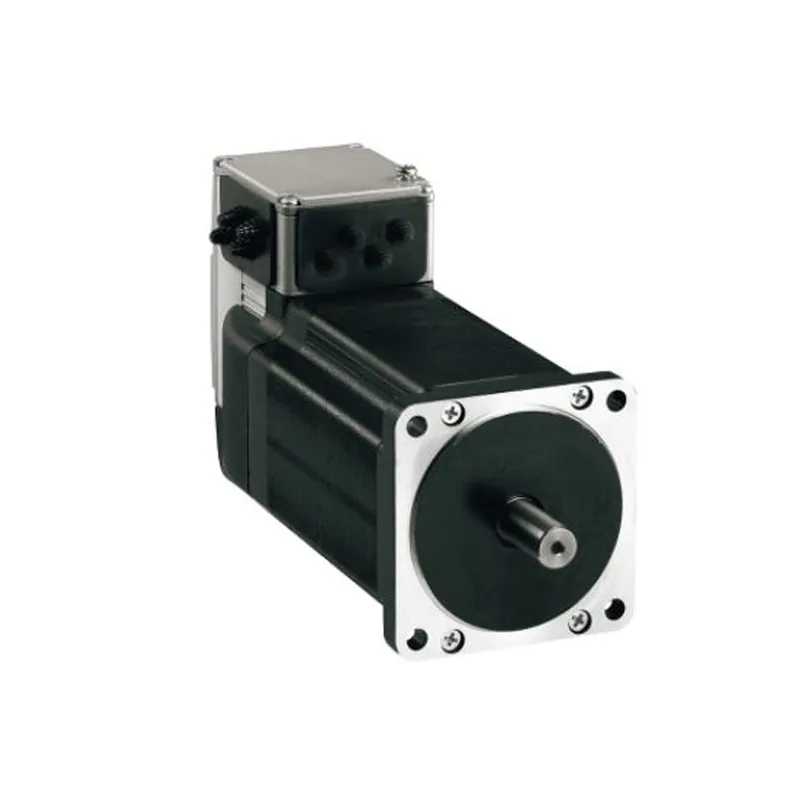
Overview
The ILS2D851PC1F0 is a Schneider Lexium integrated drive combining a 3-phase stepper motor and drive electronics in a single housing, order code ILS2D851PC1F0. It is a 6-pole, single-phase unit rated for 48 V DC supply, delivering 2 N.m of holding torque with an IP41 enclosure for in-cabinet mounting. The module carries CE marking and is built to EN 61800-3:2001 second environment standards, with a shock rating of 150 m/s² per EN/IEC 60068-2-29.
The ILS2D851PC1F0 integrates a 3-phase stepper motor and its drive controller into one package, eliminating separate cabling and panel space for a drive module. The 6-pole winding is configured for medium speed and medium torque applications, with a holding torque of 2 N.m and rotor inertia of 1.3 kg.cm². On-board DeviceNet communication handles network control and feedback, while an RS485 Modbus RTU interface at 9.6, 19.2 or 38.4 kbauds provides a secondary serial link for configuration or daisy-chaining. The feedback type is an index pulse, giving a resolution of 20000 points per turn for positioning tasks. Protection circuits include safe torque off, overload of output voltage, and short circuit of the output voltage. The drive is cooled by natural convection and operates on a 48 V DC bus with a power draw of 22.0 W.
Applications
Lexium integrated drives of this class are used in compact motion control applications where space is constrained and a separate drive and motor would not fit — typical in packaging, labeling, pick-and-place, and small conveyor indexing stations. The DeviceNet interface suits multi-axis systems already on a DeviceNet backbone, while the IP41 rating limits it to clean, dry cabinet environments.
Within Schneider's Lexium integrated drive range, the ILS2D851PC1F0 sits as a 48 V DC, 6-pole stepper variant with DeviceNet — a configuration specified when the machine network is DeviceNet and the torque requirement is moderate (2 N.m). It competes with other integrated stepper drives in the same torque class but different network protocols (e.g., CANopen or EtherCAT variants). The CE marking and EN 61800-3 compliance make it suitable for European machinery directives.