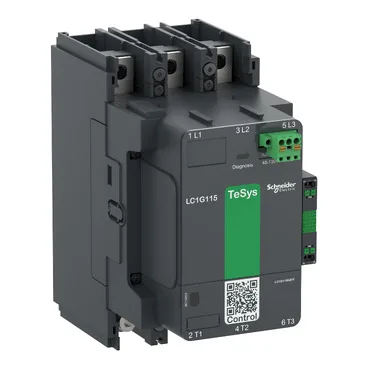
The Schneider Electric TeSys Giga LC1G185EHES207N is a 3-pole power contactor rated for motor switching up to 90 kW at 400 V AC in AC-3e duty, and 110 kW at 690 V AC-3e. The AC-3e category is the energy-efficient motor-switching class per IEC 60947-4-1, so the 90 kW figure at 400 V is the rating that governs real-world motor starts and stops — not the higher AC-1 resistive load rating. The coil accepts 48 to 130 V AC or DC, with a built-in bidirectional peak limiting circuit that suppresses switching transients without an external varistor or RC snubber. Mechanical durability is rated at 8 million cycles, and the contactor carries a B10d of 400,000 cycles under nominal load per EN/ISO 13849-1, making it suitable for safety-related stop circuits in guarded machinery. The 1 NO + 1 NC auxiliary contact block is built in, so no separate add-on module is needed for basic feedback or interlock wiring.
Mounts on a plate (not DIN rail) — the 193 mm height and 108 mm width fit a standard panel footprint. Power connections are bolted, accepting busbar cross-sections up to 25 x 6 mm or ring-terminal lugs up to 185 mm². Tightening torque for the power terminals is 18 N·m. The 35 mm connection pitch aligns with typical busbar drilling patterns. Front-face IP2X protection with shrouds per IEC 60529 and VDE 0106 means the live terminals are touch-safe once the shrouds are fitted — no additional finger-duct covers needed for standard panel access.
The associated fuse recommendations are 200 A aM or 315 A gG at 600 V, which should be coordinated for short-circuit protection. Power dissipation per pole is 20 W at AC-1 (305 A thermal current) and 6 W at AC-3 (185 A). For a panel with multiple contactors in a row, this heat load adds up — the 20 W figure is the one to use for thermal derating calculations if the contactor is running near its resistive load limit. Average impedance is 0.00017 ohm per pole. Operating rate is 600 cycles per hour for AC-3 and AC-3e, 300 for AC-1, and 150 for AC-4 (plugging/inching). The mechanical robustness spec — 4 gn vibration closed, 15 gn shock closed — confirms the contactor holds in under moderate machine vibration without dropout.