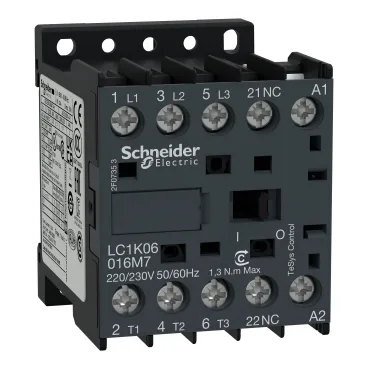
The Schneider LC1K09016M7 is a TeSys K three-pole contactor rated 9 A in AC-3 duty at 440 V, with a 220…230 V AC coil and one normally closed auxiliary contact. AC-3 is the standard category for squirrel-cage motor switching — the 9 A rating means it handles motor loads up to roughly 4 kW at 400 V, which is the spec that decides fit for a motor starter BOM line. It also carries AC-1 (resistive) and AC-4 (plugging/inching) ratings, so it covers resistive heater banks and reversing duty within its current limits. The contactor is certified to EN/IEC 60947-4-1, UL 60947-4-1, CSA C22.2 No 60947-4-1, and JIS C8201-4-1, which means it is accepted in European, North American, and Japanese panels without additional component-level testing. Flame retardance is V1 per UL 94, and the protective treatment meets IEC 60068 and DIN 50016 for tropical/humid environments.
This order code is marked obsolete by the manufacturer.
Mechanical durability is 10 million cycles, so the contactor outlasts its electrical life by a wide margin in lightly loaded or resistive circuits. The B10d value of 1,369,863 cycles at nominal load (per EN/ISO 13849-1) means it can be used in safety-related control circuits up to that cycle count before the failure probability exceeds the SIL/PL threshold — useful if the contactor is part of a monitored safety chain. The coil draws 30 VA inrush and 4.5 VA holding at 20 °C, with a control voltage range of 0.8…1.15 Uc operational and dropout at ≥0.20 Uc below 50 °C. Heat dissipation is 1.3 W. The lugs-ring terminals accept 7 mm ring lugs, torqued to 0.8…1.3 N·m with a Philips No 2 or flat Ø 6 mm driver. The single NC auxiliary contact is instantaneous, not timed, so it is suitable for interlocking or status feedback but not for delay-on-dropout logic.
The IP2X finger protection (per VDE 0106) means it is safe for open-panel installation where operators may reach near the terminals. The 2000 m altitude rating without derating covers most installations; above that, the rated current must be reduced per IEC 60947-4-1 derating curves.