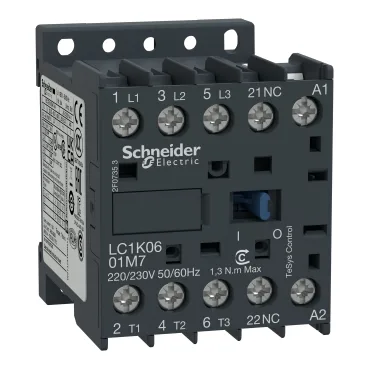
The Schneider Electric TeSys K LC1K1201B5 is a 3-pole contactor rated for 12 A in AC-3 and AC-3e utilisation categories at up to 440 V, with a 24 V 50 Hz coil and one normally closed auxiliary contact. For resistive loads (AC-1), it carries 20 A, and for inching/plugging duty (AC-4) it handles 72 A, though at much lower electrical endurance.
AC-3 means switching a squirrel-cage motor during running — making and breaking currents up to 6× rated during start, but only the motor full-load current during stop. The 12 A figure corresponds roughly to a 5.5 kW motor at 400 V three-phase. If your load is resistive (heater, lighting), the AC-1 rating of 20 A applies instead, so you get more headroom. The AC-4 rating of 72 A exists but note the electrical endurance drops to 20,000 cycles at that level — it is meant for occasional inching or reversing, not continuous plugging duty. The 1 NC auxiliary contact is built in — no add-on block needed for a basic interlock or status feedback. If you need more aux contacts, the TeSys K range offers side-mounting auxiliary blocks, but those are separate order codes. The coil draws 30 VA inrush and 4.5 VA holding at 20 °C, which is modest — a standard 24 V 50 Hz control transformer can drive several of these in parallel.
The LC1K1201B5 carries approvals across the major industrial regions: EN/IEC 60947-4-1 (Europe), UL 60947-4-1 (US), CSA C22.2 No 60947-4-1 (Canada), and JIS C8201-4-1 (Japan). It also meets the glow-wire test requirements of IEC 60335-1 and the specific air-conditioning standard UL 60335-2-40 Annex JJ. The enclosure is IP20 finger-safe per VDE 0106, so it can be mounted in a panel without additional finger-duct covers as long as the busbars are also shielded. For safety-related applications, the B10d values are provided per EN/ISO 13849-1: 1,369,863 cycles under nominal load and 20,000,000 cycles under mechanical load only. This allows the contactor to be used in a safety-related control system up to a certain SIL/PL level, provided the rest of the circuit meets the architecture requirements.
The 45 mm width (3-module) fits standard enclosure rail spacing — three of these side by side occupy 135 mm of rail. Screw-clamp terminals accept 1.5 to 4 mm² solid or 0.75 to 4 mm² flexible wire, with a tightening torque of 0.8 to 1.3 N·m. Operating altitude is 2000 m without derating; above that, the dielectric strength and thermal dissipation need to be checked against the manufacturer's altitude derating curve.