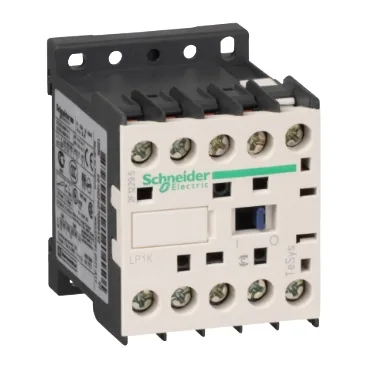
It is rated for AC-1 utilisation category, meaning it is designed for resistive loads — think heaters, ovens, or lighting banks — not motor starting. The rated operational current is 20 A at 690 V AC, 50/60 Hz, and it carries a conventional free-air thermal current (Ith) of 20 A at 50 °C. The coil is 100 V DC, so verify your control voltage before wiring. The tightening torque for the screw-clamp terminals is 1.3 N.m, using a Philips No 2 or flat 6 mm screwdriver. Get that right — under-torqued terminals are a common source of heat faults on resistive loads.
The AC-1 rating of 20 A is the headline number for this contactor. AC-1 covers resistive or slightly inductive loads where the current and voltage are nearly in phase, so there is minimal arcing on make and break. If you are switching a resistive heater bank pulling 18 A at 400 V three-phase, this contactor has the margin. Do not use it for AC-3 motor duty — that requires a different contactor rated for the higher inrush of induction motors. Rated insulation voltage (Ui) is 690 V per IEC 60947-4-1 and 600 V per UL 508 / CSA C22.2 No 14. Rated breaking capacity at 415 V is 110 A, dropping to 70 A at 660...690 V, so it can clear a fault without welding contacts. That is fine for cyclic resistive loads like a conveyor heater bank cycling on a timer. The safety reliability B10d value is 1,369,863 cycles with nominal load per EN/ISO 13849-1, which matters if this contactor is in a safety-related control circuit.
Wiring and installation notes
The contactor has 4 NO main poles. The coil operating limits are 0.8...1.15 Uc for pick-up and 0.1...0.75 Uc for drop-out at below 50 °C. For a 100 V DC coil, that means it will pick up reliably down to 80 V and drop out between 10 V and 75 V. Operating time is 30...40 ms for coil energisation and NO closing, and 10 ms for de-energisation and NO opening. The associated fuse rating for the power circuit is 25 A gG or 25 A aM. The depth of 57 mm means it stays within the typical 60 mm enclosure depth for shallow cabinets.