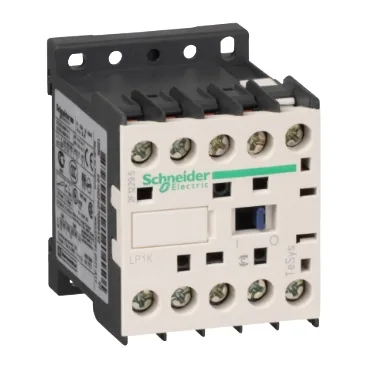
The Schneider Electric LP1K09008GD3 is a TeSys K contactor, a 4-pole device with a 2 NO + 2 NC pole configuration, designed for switching resistive loads under AC-1 utilisation category. It carries a rated operational current of 20 A at 690 V AC 50/60 Hz for the power circuit, with a conventional free air thermal current (Ith) of 20 A at 50 °C. The 125 V DC coil includes a built-in bidirectional peak limiting diode suppressor, meaning you do not need an external flyback diode for DC coil suppression — the snubber is integrated. This matters for panel builders: one less component to mount and wire, and polarity protection is handled internally.
The AC-1 rating of 20 A at 690 V tells you this contactor is sized for resistive heater banks, lighting, or transformer primary switching — not motor starts. For motor duty (AC-3), you would need a different TeSys K variant. The rated breaking capacity reaches 110 A at 415 V and 440 V, dropping to 70 A at 660–690 V, so it can interrupt fault currents up to those levels without welding contacts. The rated making capacity is 110 A AC, confirming it can close onto a short-circuit without contact damage. The rated insulation voltage (Ui) is 690 V per IEC 60947-4-1 and 600 V per UL 508 / CSA C22.2 No 14 — the part is accepted in both IEC and North American installations.
Mounts on a rail (DIN) or directly to a plate, giving flexibility in panel layout. Screw-clamp terminals accept a Philips No 2 or flat Ø 6 mm screwdriver, torqued to 1.3 N·m. The pole contact composition of 2 NO + 2 NC means you get two normally-open and two normally-closed power poles; this is not a configurable arrangement, so verify your circuit needs 2 NO and 2 NC before specifying. The operating time from coil energisation to NO closing is 30–40 ms; from de-energisation to NO opening is 10 ms. NC poles move in the opposite direction: 25–35 ms to open on energisation, 15 ms to close on de-energisation. These timing figures matter for interlocking or sequencing logic where you need to know which pole makes or breaks first.
Certified to EN/IEC 60947-4-1, UL 60947-4-1, CSA C22.2 No 60947-4-1, GB/T 14048.4, and JIS C8201-4-1 — so it is accepted across Europe, North America, China, and Japan without additional testing. Flame retardance meets V1 per UL 94, plus NF F 16-101 and NF F 16-102 Requirement 2, which is the French railway standard for fire behaviour. Operating altitude is 2000 m without derating; above that, air density drop reduces dielectric strength and cooling, so consult the thermal derating curve.