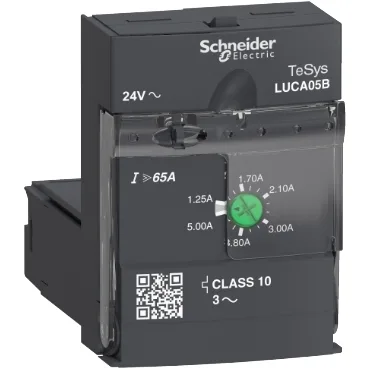
The Schneider LUCA18BTQ is a standard control unit for the TeSys U motor-starter system. It handles basic protection requirements — overload, short-circuit, earth fault, phase failure and phase imbalance — and resets manually. Rated for 7.5 kW at 400...440 V AC, 9 kW at 500 V, and 15 kW at 690 V, it covers a wide motor-power band across European and North American line voltages. Control voltage is 24 V AC, with a 20...26.5 V operating window and a 14.5 V drop-out threshold. The control circuit draws 220 mA peak at close and 90 mA sealed (with either LUB32 or LUB38 control-circuit interfaces). That sealed draw matters for transformer sizing in a multi-starter panel.
The utilisation categories — AC-41, AC-43, AC-44 — tell you this unit is rated for switching and protecting motor loads under normal and occasional starting conditions (AC-43 covers frequent starts, AC-44 covers inching/plugging). That is not a resistive-load rating; if you are switching heaters or lighting, the AC-41 category covers it, but the part is optimised for motor duty. The LUCA18BTQ itself is a control unit — it does not include the power base or the coil. It plugs into the front face of a TeSys U power base (like the LUCM series), and the control circuit needs a separate LUB32 or LUB38 interface module to connect the 24 V AC supply. If you are ordering for a new build, make sure the BOM also carries the matching power base and the control-circuit interface.
The TeSys U platform has a broad installed base, so the LUCA18BTQ is a common BOM line for panel builders maintaining or extending existing TeSys U starter assemblies. If you are stocking spares for a line that already uses TeSys U, this control unit is a direct drop-in replacement for the same rating.
The unit carries approvals under EN/IEC 60947-6-2, UL 60947-4-1, and CSA C22.2 No 60947-4-1 (with phase barriers). The front panel is IP20 (finger-safe), and the front panel outside the connection zone is IP40. Other faces are IP20 as well. The control and auxiliary circuits are safely separated at 400 V SELV from the main circuit per IEC 60947-1. That simplifies panel wiring — you can run the 24 V AC control wiring alongside the power conductors without extra insulation spacing, as long as the panel design respects the SELV limits.