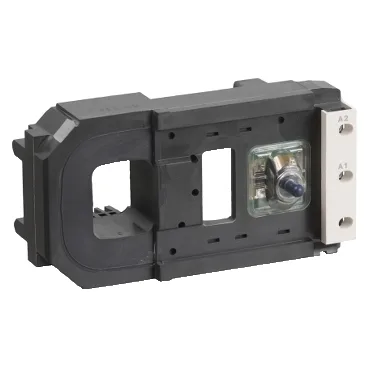
The Schneider TeSys LX1FK850 is a replacement coil for LX1F contactors, rated for 850 V AC 50/60 Hz control circuits. That 850 V coil voltage is unusual — most panel builders see 110 V, 230 V, or 400 V coils. This one is built for installations where the control transformer steps up to 850 V, common in some heavy industrial or utility substation schemes where long control cable runs need a higher voltage to overcome voltage drop. It belongs to the TeSys range, Schneider's mainstream contactor and motor-control family. The coil is the replaceable actuator that pulls the contactor in; when a contactor fails to pick or drops out under vibration, this is the part you swap up-tower or in the panel without replacing the whole contactor.
Coil electrical characteristics — the numbers that matter for fit
The coil draws 447 ohms inrush at 68 °F (20 °C) and 10637 ohms holding at the same temperature. That 24:1 ratio between inrush and holding resistance is typical for AC-operated contactor coils — the high inrush current slams the armature closed, then the holding current drops to a fraction of that. If you are sizing a control transformer for a panel with several LX1FK850 coils, the inrush load adds up fast; the holding load is negligible by comparison. There is no built-in suppressor module. That means the coil generates a back-EMF spike on de-energization that can arc across auxiliary contacts or couple noise into nearby electronics. For a wind-turbine pitch-control cabinet or a PLC-driven panel, you will want an external RC snubber or varistor across the coil terminals. The LX1F contactor base has provisions for plug-in suppressor modules from the TeSys accessory range. Operating voltage limits: the coil picks at 0.85 to 1.1 times Uc (722 to 935 V AC) and drops out between 0.3 and 0.5 times Uc (255 to 425 V AC), all at 131 °F (55 °C). The wide dropout margin means the contactor stays held during a brief sag but releases cleanly on a deep brownout. That 55 °C ambient ceiling matches the inside of a NEMA 4X enclosure in direct sun or a nacelle control cabinet in summer.
Mechanical endurance and operating rate
Rated for 10 million mechanical cycles. That is a high-durability figure for a contactor coil — it outlasts most contactor main contacts by a factor of 5 to 10. In practice, the coil will survive the life of the contactor in a cycling application like a conveyor jog station or a wind-turbine yaw drive. The maximum operating rate is 2400 cycles per hour at 131 °F (55 °C), which works out to one pick-and-drop every 1.5 seconds. That covers high-speed packaging lines and repetitive machine-tool cycles. Opening time is 100 to 170 ms; closing time is 40 to 75 ms. The closing time is fast enough for most motor-starting sequences, but the opening time is relatively slow — if you need arc-quenching speed for a short-circuit protection scheme, a contactor alone is not the right device; that is what a circuit breaker or fuse does.
Because it is active and part of the widely stocked TeSys range, lead times are typically short for a production item. The LX1FK850 is the specific order code for the 850 V AC coil variant; verify that your contactor frame size accepts the LX1F coil family before ordering.