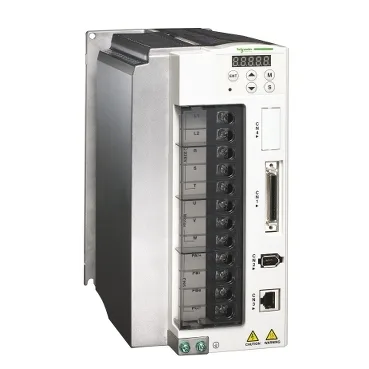
Discontinued drive — what the EOL status costs you
The LXM23DU75M3X sits on the obsolete list, so the factory channel is closed and any board-fresh units today move only through independent stock — the supply clock is whatever inventory your distributor is still holding, and the next-shield of certainty is the last-time-buy volume already booked into someone's warehouse. For a panel builder running a multi-year machine build, that read is straight-forward: spec the drive against existing on-hand stock rather than against factory lead time, because no reorder safety net remains once the lot you sourced is gone.
Power stage ratings and what they govern
The 7.5 kW nominal / 7500 W continuous rating at 220 V is the figure that sizes the motor pairing — a BSH or BDH servo in the same output class lands at the rated torque envelope of this stage without margin loss. Continuous output current of 47.5 A is the heat-sink ceiling; brief peak torque excursions ride above it on the drive's overload curve, but the steady-state RMS must stay inside that figure or the IGBT junction derating kicks in. Supply limits are 170...255 V three-phase at 47.5...63 Hz, so on European 400 V delta services you must step the line down to 220 V star — feeding 400 V directly will cross the upper rail and trip the input stage.
Book-format chassis and panel-side integration
Book-format mounting means the unit cuts a flat sidewall slot rather than stacking on a DIN rail — book drives pair up tightly side-by-side inside a cabinet, which is how Schneider fits multiple axes into a compact cell envelope. Maximum leakage current of 3.5 mA puts this drive on a fixed-input grounding scheme (TN-S or grounded wye) — the residual-current device upstream must be Type B or the DC ground-fault component will saturate a Type A breaker and refuse to trip.