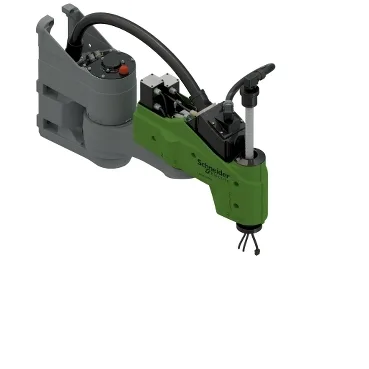
STS60 wall-mount: 4-axis SCARA on 8 kg of headroom
The LXMSTS60W200000: Operational envelope is ±0.01 mm repeatability at the tool flange with an operating travel of 0–200 mm vertical and 0–1200 mm horizontal — the horizontal envelope is the dimension that decides whether the robot fits the cell footprint, and the ±0.01 mm figure is the one that drives pick-and-place vs insertion-grade application fit.
Axis speeds — per-axis numbers decide the actual cycle time
Axis 4 carries the wrist and posts 1200°/s nominal, 1929°/s maximum; axes 1 and 2 (the shoulder and elbow, where inertia dominates the cycle) hit 385°/s and 500°/s nominal, with 490°/s and 610°/s maximum respectively. For a 4-axis SCARA the slow shoulder is what governs standard-cycle 25/305/25 benchmarks, not the wrist — the wrist headroom beyond 1900°/s only matters when the application keeps the wrist as the dominant move.
Lifecycle reads obsolete — sourcing posture changes with it
Schneider has marked LXMSTS60W200000 obsolete; no official successor or cross-reference is recorded in the ledger for this SKU, so any pin-compatible alternative would need to be confirmed with the manufacturer — not assumed. For a contract build, obsolete on a robot means a deviation request lands on the desk before the part hits the AVL line. Sourcing posture for an obsolete PacDrive 3 STS60 is independent-channel and lot-confirmed: each quote is scoped against what is on hand in the supply base, with traceability paperwork and quantity bracket quoted at RFQ time. On a multi-client contract line the customer's AVL still binds — this part is sourced through channels that already need an approved alternate or deviation note per the AML before it ships into build.