Supply-voltage-dependent speed and torque — the real selection constraint
The SH30551P01A1000 is a three-phase servo motor from Schneider's SH3 series, but its nominal speed and torque are supply-voltage-dependent: at 115 V single phase it delivers 2000 rpm and 0.5 N.m; at 480 V three phase it reaches 8000 rpm with 0.35 N.m nominal torque. That means the same motor frame covers a 4:1 speed range depending on the drive's DC bus voltage — critical for a BOM that must work across global line voltages. Continuous power is 290 W, with nominal output power varying from 100 W at 115 V single phase up to 440 W at 480 V three phase. The motor is rated for natural convection cooling — no fan, so heat rejection depends on the mounting flange's thermal path to the machine frame.
Absolute Hiperface encoder — no homing sequence needed
The absolute single-turn SinCos Hiperface encoder provides position feedback on power-up without a reference run — the drive knows the rotor angle immediately. This saves cycle time in multi-axis machines where homing would otherwise add seconds per axis on every startup. Back EMF constant is 40 V/krpm at 20°C, and torque constant is 0.58 N.m/A at 120°C hot winding temperature. The 130°C copper temperature limit sets the thermal budget for continuous stall current of 0.73 A and continuous stall torque of 0.42 N.m. Peak stall torque reaches 1.5 N.m at 115-480 V three phase with a 2.9 A peak current for up to 3 seconds — useful for breaking static friction or accelerating a load through a short high-torque window.
Smooth shaft, no brake — coupling and load-holding decisions
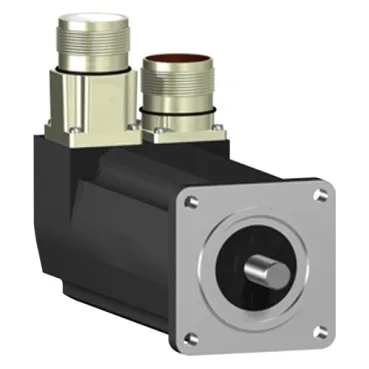
The shaft is smooth (no keyway) with a 9 mm diameter and 20 mm engagement length. This requires a clamping-type coupling or a friction-lock pulley — no positive drive via key. Maximum radial force Fr derates with speed: 340 N at 1000 rpm down to 170 N at 8000 rpm; maximum axial force Fa is 40 N.
Active production — sourced to order
The 55 mm international standard flange with 40 mm centring collar and 5.5 mm mounting holes fits standard servo-mount patterns. Electrical connection options are a rotatable right-angled connector or a straight connector — choose based on cable exit clearance in the panel.