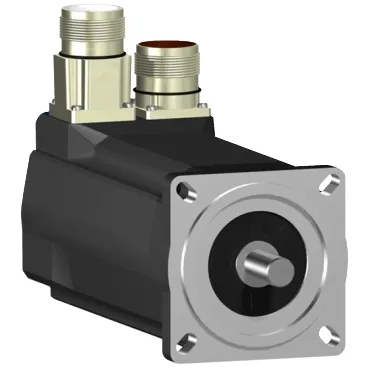
Power and speed across supply voltages
The SH30701P01A1200 delivers 690 W continuous power from a 70 mm flange frame, but its speed and torque curves shift with the supply voltage. On 400 V three-phase, nominal speed is 6000 rpm with 1.1 Nm torque; on 480 V three-phase, that climbs to 7200 rpm at the same torque. For single-phase 230 V, expect 3000 rpm and 1.4 Nm — the torque stays higher but the speed ceiling drops. Peak stall torque reaches 3.5 Nm across the 115–480 V three-phase range, enough for short acceleration bursts. Continuous stall torque sits at 1.25 Nm, so the motor can hold position at rated current indefinitely without overheating the windings.
Encoder feedback and environmental sealing
The absolute single-turn SinCos Hiperface encoder gives position feedback on power-up without a homing sequence — useful on lines where the machine must resume after a power cycle without re-referencing. The motor body and shaft bushing carry IP65, while the housing meets IP67 per IEC 60034-5, so it handles washdown in food-and-beverage or wet processing areas. No holding brake is fitted on this variant. For vertical-axis loads or applications that must hold position with power off, you will need an external brake or a different motor from the SH3 family with the brake option.
Mechanical limits for belt and pulley loads
Maximum mechanical speed is 8000 rpm — stay below this even if the drive can command higher. The radial force the bearings can handle drops with speed: 660 N at 1000 rpm, down to 360 N at 6000 rpm. If you are driving a belt or pulley, check the radial load at your operating speed against this curve to avoid premature bearing wear. Maximum axial force on the shaft is 80 N. The smooth 11 mm shaft with a 23 mm engagement length accepts a clamp-on coupling; there is no keyway, so torque transmission relies on the clamping force of the coupling hub.