Motor sizing and speed range across supply voltages
The SH31002P0AF4100 delivers 1930 W continuous power at 400 V or 480 V three-phase supply, dropping to 1090 W on 230 V single-phase input. Nominal speed shifts with the supply: 2000 rpm at 230 V single-phase, 4000 rpm at 400 V three-phase, and 4800 rpm at 480 V three-phase. Nominal torque also varies by supply — 5.2 N.m at 230 V single-phase, 4.6 N.m at 400 V three-phase, and 4.4 N.m at 480 V three-phase. The continuous stall torque is 5.8 N.m across the 115...480 V three-phase range, giving the torque available at zero speed without overheating the windings. Peak stall torque reaches 18.3 N.m for short-duration acceleration or deceleration events, with a corresponding peak current of 17.1 A for up to 3 seconds. This overload capability is what drives the acceleration torque calculation for the load inertia.
Encoder feedback and brake integration
The absolute single-turn Hiperface DSL encoder provides position feedback within one revolution without battery backup — the position is retained on power loss as long as the motor hasn't rotated past one turn. This eliminates the need for a homing sequence after a power cycle in single-turn applications.
Mounting, cooling, and environmental sealing
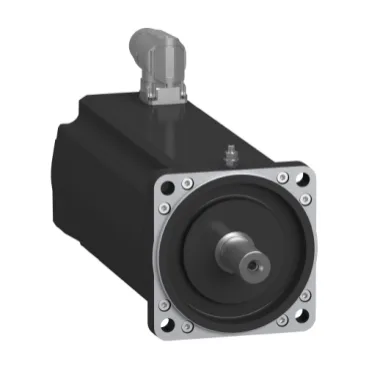
The motor uses an international standard flange with a 100 mm flange size and 9.0 mm mounting holes. The centring collar depth is 3.5 mm for concentric alignment on the mating surface. The smooth shaft (19 mm diameter, 40 mm shaft length) requires a clamping or friction-fit coupling — no keyway is provided. Cooling is by natural convection — no external fan, so the motor relies on its surface area and the mounting plate for heat dissipation. The winding insulation is rated for a copper hot temperature of 130 °C. IP65 protection on both the motor body and shaft bushing means the unit withstands washdown environments per IEC 60034-5. Electrical connection options include a straight connector or a quick-lock rotatable right-angled connector, giving flexibility for cable routing in tight cabinets. The overall body length is 235.5 mm.
Electrical parameters for drive tuning
The torque constant is 1.21 N.m/A at 120 °C — the motor's current-to-torque gain at operating temperature. The back EMF constant is 77 V/krpm at 20 °C, which determines the voltage the motor generates at speed and affects the drive bus voltage margin needed to reach rated speed. Stator resistance is 2.4 Ohm and stator inductance is 6.75 mH — these values influence the current ripple and the drive's current-loop tuning parameters. The motor has 4 poles, so the electrical frequency at 4000 rpm is 133.3 Hz.
Bearing load limits and mechanical constraints
Maximum radial force on the shaft varies with speed: 2420 N at 1000 rpm, 1920 N at 2000 rpm, and 1670 N at 3000 rpm. Maximum axial force is 300 N. These limits govern the allowable belt tension, gear mesh forces, or direct coupling misalignment the bearings can tolerate without premature failure.