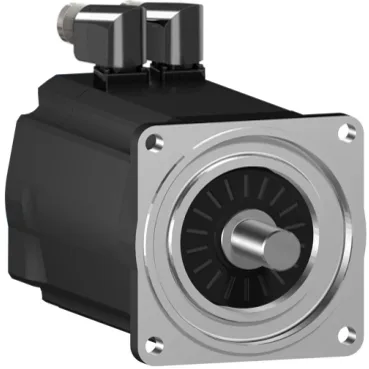
1900 W continuous power, 4.6 Nm at 400 V three-phase — the design point
The SH31002P12A2100 is a Schneider Electric SH3 series servo motor rated for 1900 W continuous power at 400 V three-phase supply, delivering 4.6 Nm nominal torque at 4000 rpm. This is the design-point rating for sizing the drive and mechanical load. Performance varies significantly with supply voltage and phase: at 115 V single-phase, nominal torque drops to 5.5 Nm at 1000 rpm with 580 W output; at 480 V three-phase, torque is 4.4 Nm at 4800 rpm with 2210 W output. The 400 V three-phase rating is the most common industrial configuration.
Peak vs continuous torque — the overload margin
Peak stall torque is 18.3 Nm across the 115–480 V three-phase range, while continuous stall torque is 5.8 Nm. This 3.15:1 ratio defines the short-duration overload capability for acceleration and deceleration cycles without demagnetization. The motor uses natural convection cooling (no fan), so continuous torque is limited by the IP65 sealed housing's ability to dissipate heat. The copper winding temperature limit is 130 °C.
Absolute multiturn SinCos Hiperface encoder — drive compatibility
The encoder is an absolute multiturn SinCos Hiperface type, providing position feedback without a battery backup for multi-turn counts. This determines drive compatibility — the servo drive must support the Hiperface protocol (common on Schneider Lexium, but also supported by third-party drives with the right interface module). The electrical connection uses a rotatable right-angled connector, allowing cable exit orientation to be adjusted during installation — useful in tight cabinet layouts or when the motor is mounted in a confined space.
IP65 sealed — washdown-capable, no brake variant
Both the motor body and shaft bushing are rated IP65 per IEC 60034-5, meaning the motor withstands hose-directed water and dust ingress. This suits food-and-beverage processing lines, washdown zones, or outdoor installations where moisture is present.
Radial force limits — bearing load vs speed
Maximum radial force Fr on the shaft drops with speed: 990 N at 1000 rpm, 790 N at 2000 rpm, 690 N at 3000 rpm, and 620 N at 4000 rpm. For belt- or pulley-coupled loads, the actual radial load at the operating speed must stay below this curve to avoid bearing fatigue. Maximum axial force Fa is 160 N. The shaft end uses a parallel key (6 mm key width, 19 mm diameter, 40 mm shaft length) on a 100 mm flange with international standard mounting.