Motor performance across supply voltages
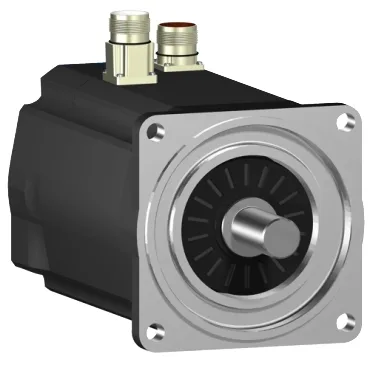
The SH31003P02A1200: This SH3 series servo motor delivers a continuous power of 2400 W, but the torque and speed envelope shifts significantly depending on the supply voltage. At 480 V three-phase, nominal torque is 45.1 lbf·in (5.1 N·m) at 4800 rpm; at 115 V single-phase, torque rises to 66.4 lbf·in (7.5 N·m) but speed drops to 1000 rpm. Peak stall torque reaches 250.5 lbf·in (28.3 N·m) across the 115...480 V three-phase range, giving the headroom needed for rapid acceleration cycles on indexing or pick-and-place axes. Continuous stall torque is 70.8 lbf·in (8 N·m) — this is the holding torque available at zero speed without exceeding the thermal limit of the natural convection cooling.
Encoder feedback and mechanical fit
The absolute multiturn SinCos Hiperface encoder provides position feedback without a homing cycle on power-up — critical for applications where the machine must resume operation after a power loss without re-referencing. Motor flange size is 100 mm (3.9 in) with a centring collar diameter of 95 mm (3.7 in) and a depth of 3.5 mm (0.1 in) — standard international flange dimensions that mate with common gearbox and mounting brackets. The smooth shaft (19 mm diameter, 40 mm length) requires a shaft coupling with a clamping hub — no keyway is provided, so the coupling must transmit torque through friction alone. IP65 on the motor body and shaft bushing, IP67 on the housing — this motor is sealed for washdown environments like food processing or packaging lines where high-pressure cleaning is routine.
Electrical parameters for drive setup
Stator resistance is 1.43 Ω and stator inductance is 4.7 mH — these values go into the drive's autotuning routine for current loop and velocity loop gains. Torque constant is 1.22 N·m/A at 120 °C copper temperature; back EMF constant is 77 V/krpm at 20 °C. The drive's voltage margin must account for the back EMF at top speed — at 4800 rpm the motor generates 370 V line-to-line, leaving 110 V headroom on a 480 V bus for current regulation. Maximum continuous stall current is 6.6 A; peak current (3 s) is 28.3 A. The drive must be sized for the peak current during acceleration, not just the continuous rating. Four-pole motor — set the drive's motor pole count parameter to 4 for correct speed feedback and slip compensation.