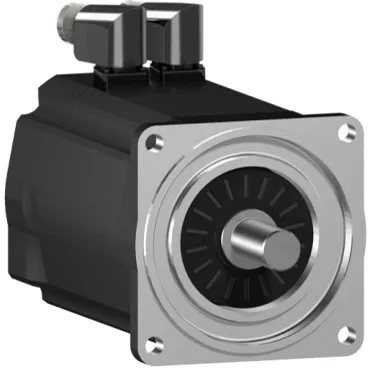
Nominal speed and torque — voltage-dependent performance
The SH31003P02F2200 is a three-phase servo motor with holding brake, part of Schneider Electric's SH3 series. Its nominal speed shifts with the supply: 1000 rpm at 115 V single-phase, 2000 rpm at 230 V single-phase, 4000 rpm at 400 V three-phase, and 4800 rpm at 480 V three-phase. Nominal torque also varies by voltage — 45.1 lbf.in (5.1 N.m) at 480 V three-phase up to 66.4 lbf.in (7.5 N.m) at 115 V single-phase. That means the same motor delivers different output depending on the line voltage you feed it; the 480 V three-phase connection gives the highest speed but the lowest torque, while the 115 V single-phase connection gives the highest torque at lower speed. Continuous power is 2400 W, and the motor uses natural convection cooling. The encoder is an absolute multiturn SinCos Hiperface type — this gives high-resolution position feedback without needing a home cycle on power-up, which saves time on multi-axis machines.
Environmental sealing and mounting
The motor carries IP65 on the body and shaft bushing, and IP67 on the housing — conforming to IEC 60034-5. That means it handles washdown environments directly; the housing seal keeps out high-pressure water jets, while the shaft bushing seal protects the bearing area. The flange size is 100 mm (3.9 in) with an international standard flange, and the centring collar diameter is 95 mm (3.7 in) with a 3.5 mm depth. Mounting holes are 9.0 mm diameter on a standard pattern. The shaft is smooth, 19 mm diameter and 40 mm long. The electrical connection uses a rotatable right-angled connector — this lets you orient the cable exit to fit tight panel layouts without adding a right-angle adapter.
Stall torque, inertia, and braking
Continuous stall torque is 70.8 lbf.in (8 N.m) across the 115–480 V three-phase range. Peak stall torque hits 250.5 lbf.in (28.3 N.m) at the same voltage range — that's about 3.5× the continuous figure, useful for short acceleration bursts. The holding brake delivers 79.7 lbf.in (9 N.m), which holds the load at rest without power to the motor windings.