Flange size, shaft, and encoder — what fits the machine
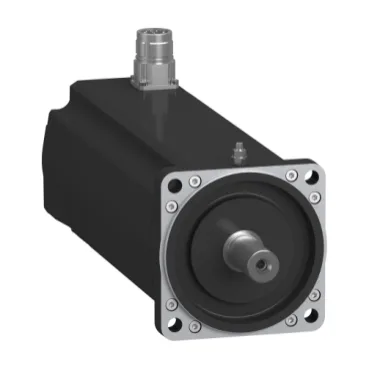
The SH31003P0AF3000: This SH3 frame carries a 100 mm flange (3.9 in) with a 19 mm diameter smooth shaft, 40 mm long — the centering collar is 95 mm diameter, 3.5 mm deep, and the four mounting holes are on a 9.0 mm diameter pattern. That lands it in the common IEC 100 mm bolt circle; the smooth shaft means no keyway, so the coupling or pulley clamps directly onto the shaft OD. The feedback is an absolute single-turn Hiperface DSL encoder — one cable carries both power and data, which cuts the cable count versus a separate encoder line. Single-turn means it knows position within one revolution at power-up; no home-find move needed after a power cycle. The straight quicklock connector mates with the matching drive cable and locks without tools.
Speed-torque curves across supply voltages
The motor delivers different nominal torque and speed depending on the supply. On 230 V single-phase it spins to 2000 rpm with 62.0 lbf·in (7 N·m) nominal torque; on 400 V three-phase it reaches 4000 rpm with 50.4 lbf·in (5.7 N·m); on 480 V three-phase it hits 4800 rpm with 45.1 lbf·in (5.1 N·m). Nominal output power sits at 1470 W on 230 V and 2390 W on both 400 V and 480 V three-phase supplies. The continuous power rating is 2400 W, and the continuous stall torque across the 115–480 V three-phase range is 70.8 lbf·in (8 N·m) at 6.6 A continuous stall current. Peak stall torque hits 250.5 lbf·in (28.3 N·m) at 28.3 A maximum RMS current — that is the short-term burst for acceleration through a cycle.
Holding brake and thermal limits
The holding brake is engaged when the motor is unpowered — it holds 79.7 lbf·in (9 N·m) static torque, which matches or exceeds the continuous stall torque. The brake pull-in power is 18 W; that is the coil power needed to release the brake. If the brake fails to release on power-up, check the 18 W supply to the brake coil before pulling the motor. The motor is naturally convection cooled — no fan, so the thermal time constant depends on the mounting flange's ability to sink heat into the machine frame. The stator resistance is 1.43 Ω and inductance is 9.4 mH; the torque constant is 1.22 N·m/A at 120 °C copper temperature, and the back EMF constant is 77 V/krpm at 20 °C. The maximum copper hot-spot temperature is 130 °C — the drive's current limit should be set to keep the I²R heating within the natural convection envelope.
Environmental sealing and mechanical loading
The motor body is rated IP65 per IEC 60034-5 — sealed against dust and low-pressure water jets, so it handles washdown in food or beverage lines as long as the cable connector is mated. The shaft bushing without the optional shaft seal ring drops to IP54, so if the application sees direct spray on the shaft face, add the seal ring to maintain IP65.