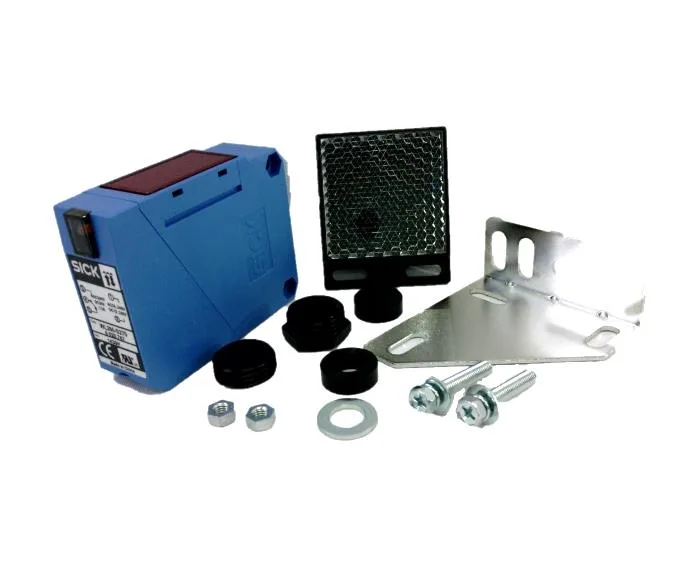
The SICK WL260-S270 is a photoelectric retro-reflective sensor with a dual-lens optical system, meaning it uses a reflector (sold separately) to bounce the LED beam back to the receiver. The dual-lens design separates emitter and receiver optics, which gives it better immunity to contamination on the lens face compared to single-lens retro-reflective sensors — a real advantage on dusty or misty lines where a single-lens unit would false-trigger. Sensing range runs from 0.01 m out to 15 m with the supplied reflector, covering everything from part-present detection on a close conveyor to pallet positioning at the end of a long aisle. The 1.7° beam angle and 300 mm spot size at distance mean alignment is forgiving — you don't need a laser pointer and a prayer to get it aimed. Output is a relay with change-over contacts (SPDT), electrically isolated, rated to switch 3 A. That makes it a direct fit for PLC digital inputs, contactor coils up to the contact rating, or alarm annunciators — no external interposing relay needed for most loads. The relay pulls in on light condition (light switching mode), so a loss of power or a blocked beam both drop the output; that's fail-safe by default. Supply voltage is 12 V DC to 240 V DC. Power consumption is ≤ 5 VA. Response time is ≤ 20 ms, switching frequency 25 Hz.
The WL260-S270 is a standard rectangular-body photoelectric sensor, through-hole or bracket mount. It's not a DIN-rail module — you bolt it to a machine frame or conveyor stand, aim it at a reflector, and wire the three relay terminals back to the panel.