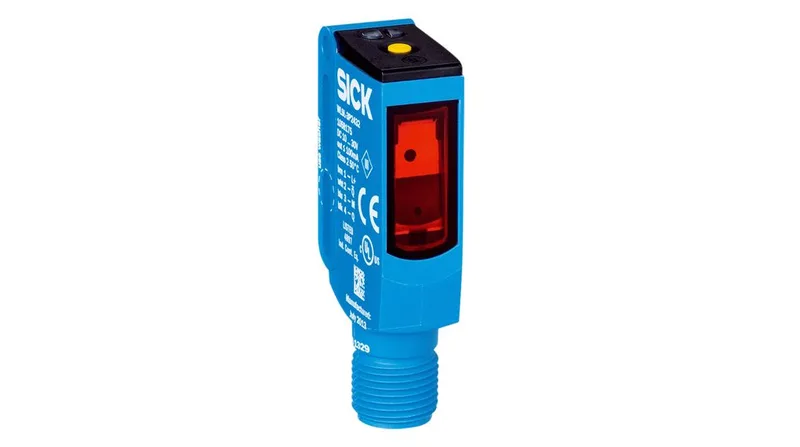
The SICK WL9L-3P2432 is a W9-series photoelectric retro-reflective sensor that uses a red laser emitter to detect objects at distances up to 12 m. The laser spot stays tight over the full range, which means it picks up small targets or narrow gaps that a standard LED retro-reflective would miss. The 500 µs response time keeps up with fast-moving parts on a conveyor or pick-and-place cycle — no missed counts at line speed. The housing is sealed to IP66, IP67, and IP69K, so it survives high-pressure washdown and steam cleaning on food, beverage, or pharmaceutical lines. The M12 4-pin connector makes swap-out fast — no hardwiring into the gland plate.
The 12 m sensing distance is the rated range with a standard reflector (e.g., SICK PL80A). In practice, derate for dust, fog, or a dirty reflector — but the laser's collimated beam holds range better than a visible red LED in those conditions. The 500 µs response time means the sensor can detect a 10 mm target moving past at roughly 20 m/s before the output misses it. The switching mode is selectable Light-ON or Dark-ON via the teach-in or wiring, so the same part handles presence or absence detection without a different order code. Supply voltage range is 10–30 VDC, which covers 12 V and 24 V control systems without a separate regulator. The operating temperature window of -10 °C to +50 °C is typical for indoor industrial use; if the line sees freezing or hot washdown cycles, check the W9G variant with the wider -40 °C to +60 °C range.
The housing footprint is 12.2 mm wide by 52.2 mm tall — it fits the standard W9 slot pattern and shares the same mounting hole spacing as the rest of the W9 family. If you're replacing a W9 LED retro-reflective (like the WL9G-3P2432), the laser version is a drop-in swap on the bracket; just verify the reflector alignment because the laser beam is narrower than the LED beam.