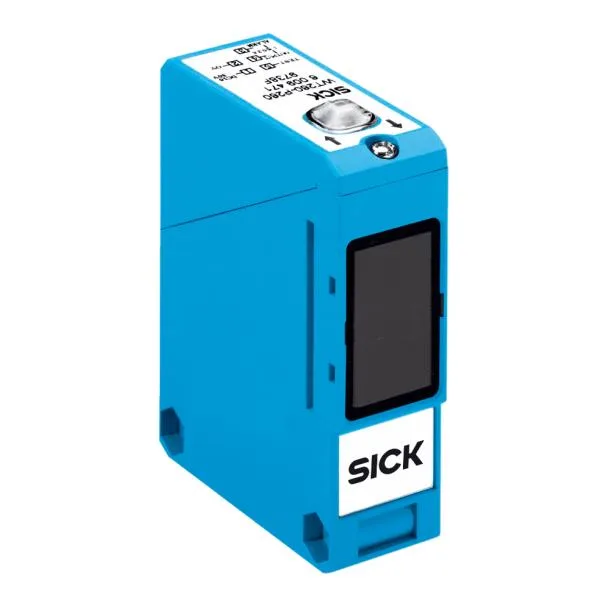
The SICK WT260-P260 is a rectangular photoelectric proximity sensor with background suppression — meaning it detects objects within the set range while ignoring reflective surfaces beyond it, a key advantage on conveyors or packaging lines where the belt or backstop could otherwise trigger false readings. Sensing range is 0 to 380 mm, so it covers a typical pick-and-place or part-present zone without needing a separate reflector or receiver — the emitter and detector share the same housing. Switch output is PNP, sourcing up to 100 mA — that drives standard PLC inputs or small relays directly, but watch the load: 100 mA is the absolute maximum, not a continuous rating for an inductive load without a flyback diode. Supply voltage is 10 … 30 V DC, with 24 V DC nominal — common for industrial control panels. The 35 mA current consumption means it won't strain a 24 VDC power supply shared across a row of sensors. Switching frequency of 250 Hz — fast enough for counting parts at moderate line speeds, but not for high-speed sorting or encoder-like applications. IP66 enclosure rating — dust-tight and protected against powerful water jets, so it holds up in washdown areas or dusty environments without a secondary enclosure. Ambient operating temperature -25 … 55 °C — fine for most indoor factory floors; derate if mounted near a hot motor or oven.
Rectangular body, 25 × 77.8 × 63 mm, with a cable gland connection — mounts via the two through-holes in the plastic housing, typically on a bracket or machine frame. The 270° potentiometer lets you fine-tune the background-suppression threshold on the fly. Focus is approximately 1.5° — a narrow beam that helps reject side reflections and keeps the detection zone tight to the target.