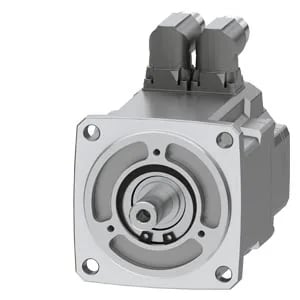
What this servo brings to a robot or motion cell
The 1FT2208-3AC90-2RB0-Z L1A+P90+Q01 is a SIMOTICS S-1FT2 CT synchronous servo from the Siemens 1FT2 compact family — 18 Nm stall torque with a 3.05 kW rated point at nN=2000 r/min, sized as the workhorse axis in a robot or pick-and-place cell where mid-payload dynamics matter more than peak speed. Feedback is resolver 2-pole (not absolute encoder), paired with an integrated Pt1000 winding thermistor; the holding brake means the axis holds position on a vertical or cantilevered load without active torque after a stop — that is what makes it drop-in for a Z-axis on a palletizer or a part-transfer slide. Wiring is split: a 17-pin M17 signal connector (resolver + brake + thermistor leads) and an M23 power connector — both are keyed, single-position, so the cell wiring harness has to be built around this pinout, not retrofitted from a generic servo cable.
Production status and order-code discipline
Siemens lists the lifecycle stage as current, so the order code is still being accepted against fresh production BOMs — the suffix L1A+P90+Q01 is part of that configured order, not a separate variant. Product class is defined as manufactured / produced to order, which cannot be reused, re-utilized, or returned against credit — meaning the unit is built once for a specific order, so the full configured MPN string is the BOM contract; substitutions or partial returns are not on the table.
Sourcing posture for the configured order code
Because this is a made-to-order configuration with three appended option codes, the realistic procurement move is to quote against the complete 1FT2208-3AC90-2RB0-Z L1A+P90+Q01 string rather than treat it as a catalog line item — availability and lead time for the configured unit are confirmed at the RFQ stage against Siemens' configured-order backlog. Group Code R220 and Product Group X033 are internal Siemens ordering-data tags (administrative, not functional ratings) — they line the part up inside Siemens' ordering system but do not appear on the cell-side integration drawings.