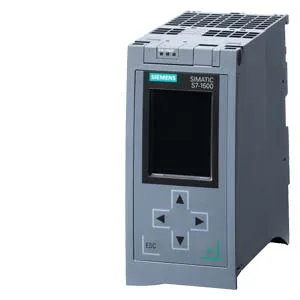
It handles a 400 V three-phase motor load up to 5.2 A in AC-3 duty (2.2 kW), with a 24 V DC control supply. The overload relay is adjustable from 4.5 to 6.3 A, so you set it to the motor nameplate FLA within that window. This is a safety-rated device: it achieves category 3 per EN 954-1 and SIL 2 per IEC 61508. That means it's designed for guarding applications where a fault in the safety circuit must not lead to loss of the safety function — think hazard zones, press controls, or emergency-stop circuits on a production line. It supports automatic start and monitored start-up, and includes an EMERGENCY OFF function. The enclosure is IP20 — finger-safe in a cabinet, but not for washdown. Screw terminals on the main circuit keep wiring straightforward for panel builders.
The 5.2 A AC-3 switching current at 400 V is the motor-load rating — that's the current it can break reliably under starting conditions (inductive load with high inrush). The 2.2 kW power figure at AC-3 is the same rating expressed as motor output. For resistive loads (AC-1), the current capability would be higher, but the AC-3 number is the one that governs motor duty. The overload setting range of 4.5 to 6.3 A covers common small motor sizes. The 50 kA SCCR at 400 V means this feeder can be placed downstream of a 50 kA-rated upstream breaker without needing a current-limiting device — that's a strong rating for an S0-size unit. The 24 V DC control voltage is fixed; there's no AC coil option on this variant. The supply frequency for the auxiliary circuit is listed as 0 Hz — it's pure DC, so no frequency dependency. The unit has no bus communication (no PROFIBUS, no AS-interface), so it's a standalone safety starter, not a networked node.