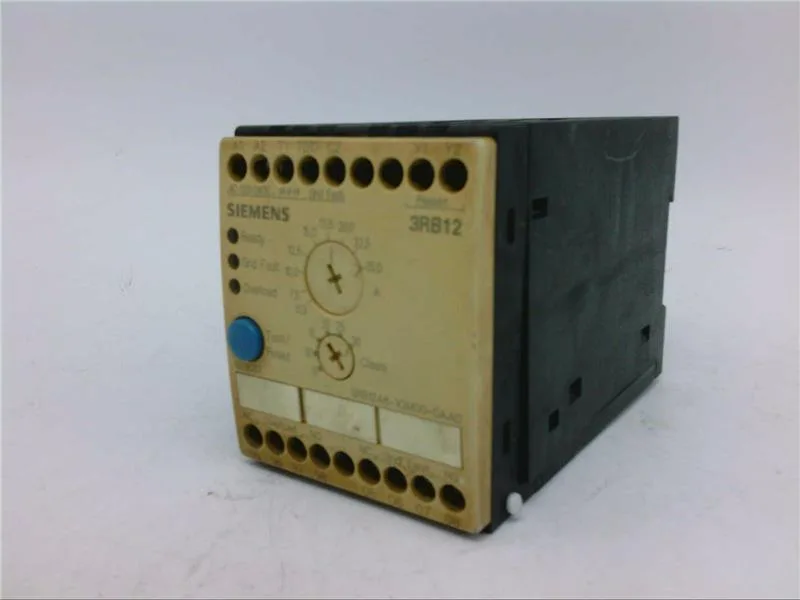
The Siemens 3RB1246-1PG01 is an overload relay for full motor protection, sized for the S00/S0 contactor frame. It covers a 1.25 to 6.3 A motor FLA range with adjustable trip Class 5 through 30 — so you can dial in the protection curve for the load: fast trip for short-stroke pumps, slower for high-inertia fans that need the start transient to pass. The main circuit uses a current transformer; the auxiliary circuit lands on screw terminals. Control voltage is AC 110-120 V, 50/60 Hz. It offers manual, automatic, and remote reset options, plus bistable outputs and ground fault signaling — useful for an MRO planner who needs to know which motor tripped and why, before walking the route.
The 1.25-6.3 A range covers a common band of small to mid-size motors — fractional-horsepower pumps, small conveyors, fan motors in the 0.5 to 3 hp range on 480 V. The Class 5-30 adjustment lets you match the thermal model to the motor's starting duty. Class 10 is the standard for most general-purpose motors; Class 20 or 30 buys you the headroom for high-inertia starts without nuisance tripping. Bistable outputs mean the relay holds its trip state even if control power is lost — a commissioning engineer will appreciate that during FAT when the panel gets powered down and back up. Ground fault signaling is a step above a basic overload block — it detects leakage to ground, which matters on motors in wet or dusty environments where insulation degradation is a real risk. The AC 110-120 V control coil is standard for North American panels running on a 120 V control transformer.
Deployment context
This relay mounts individually — no DIN rail required for the S00/S0 frame, though it can sit on a DIN rail in the panel. It mates to Siemens S00 or S0 contactors, so a panel OEM wireman will land the motor leads on the contactor output and run the control wiring to the relay's screw terminals. The manual-auto-remote reset selector is a time-saver on a line: set to auto for unmanned stations, remote for a PLC reset signal, or manual for troubleshooting.