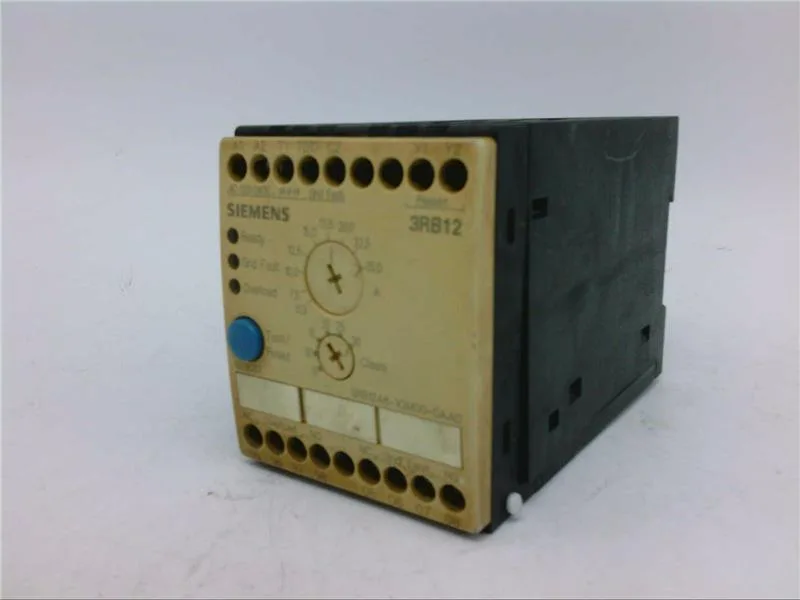
The Siemens 3RB1246-1PM31 is a solid-state overload relay from the SIRIUS 3RB1 family, designed for motor protection in control panels. It combines three protection functions in one unit: overload protection via a solid-state sensing circuit, thermistor motor protection (PTC) for winding temperature monitoring, and internal earth-fault detection. The relay operates on a 220 to 240 V AC control supply at 50/60 Hz and covers a current setting range of 1.25 to 6.3 A. The output configuration provides two separate signal paths: a 1NO/1NC contact pair for the combined overload/thermistor/earth-fault trip, and a separate 1NO/1NC pair for an overload warning. All outputs are bistable, meaning they latch in the tripped state after a fault and require a manual or remote reset — a deliberate design choice for fail-safe operation on unattended or remotely monitored lines.
The 1.25 to 6.3 A current range positions this relay for small to medium motor loads — fractional-horsepower pumps, fans, compressors, and conveyor drives up to roughly 3 kW at 400 V. The solid-state sensing circuit eliminates the heating element found in bimetallic relays, so the trip characteristic is independent of ambient temperature drift in the panel. This matters when the relay shares a crowded enclosure with drives or transformers that raise internal temperatures. The integrated thermistor protection (PTC) circuit connects directly to PTC sensors embedded in the motor windings. This catches over-temperature conditions that overload current alone may not detect — stalled rotor with low current draw, blocked ventilation, or high ambient heat at the motor. The earth-fault detection monitors leakage current to ground, adding a layer of protection that a standard overload relay cannot provide without an external ground-fault module. Bistable outputs mean the relay holds its trip state even if the control supply is lost. For a maintenance technician arriving at a downed line, the relay's front-panel indicator shows the last fault type (overload, thermistor, or earth fault) without needing power applied. This speeds fault isolation on multi-motor cells.
Sourcing is straightforward through the authorized channel. For procurement teams managing a multi-year project, the current lifecycle status provides confidence that the part will be available for the duration of the build.