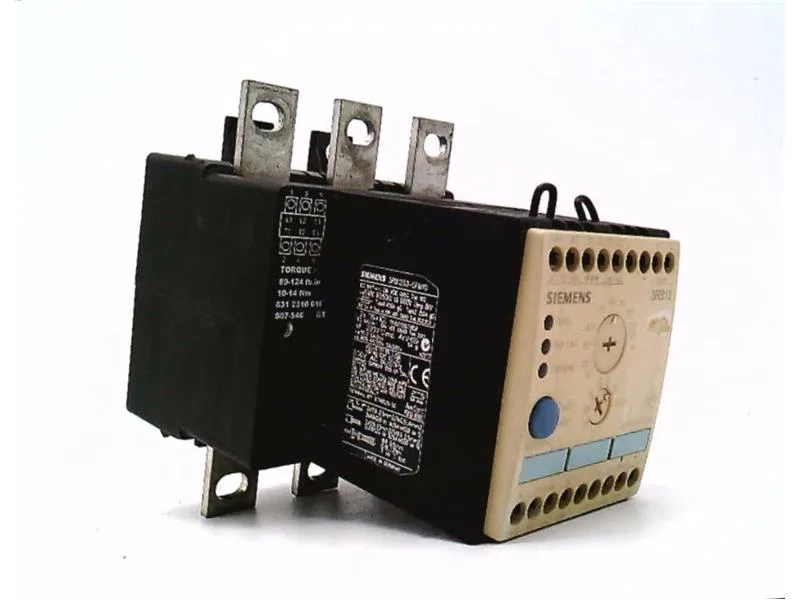
It integrates thermistor motor protection (PTC) directly into the relay body — no separate evaluation module needed — and monitors ground faults through an external summation current transformer (Kloeckner-Moeller ZWA205). The output configuration gives you 1 NO + 1 NC for overcurrent/thermistor status and a separate 1 NO + 1 NC for ground-fault alarm, both monostable (self-resetting when the fault clears).
The 50-205 A current range covers medium-to-large induction motors — think 30-90 kW at 400 V three-phase. The 24 V DC control supply is standard for PLC-driven panels; verify your cabinet's DC bus can deliver the relay's coil draw without a separate power supply. The ground-fault monitoring via an external summation CT means you're not limited to the relay's internal zero-sequence sensor — you can size the CT to match the feeder's sensitivity (typically 300 mA to 30 A trip). The monostable output resets automatically, so a momentary ground fault won't latch the relay into a trip state that requires a manual reset at the panel.
This relay mounts on a DIN rail in the motor control center (MCC) or distribution panel. The external summation CT (ZWA205) installs around the three-phase conductors or the neutral-ground bond, depending on your ground-fault scheme. Wire the PTC thermistor chain from the motor winding directly into the relay's thermistor input terminals — no intermediate module. The two sets of NO/NC contacts (overcurrent/thermistor and ground fault) can feed separate alarm inputs to the PLC or a hardwired safety circuit, keeping fault isolation clean.