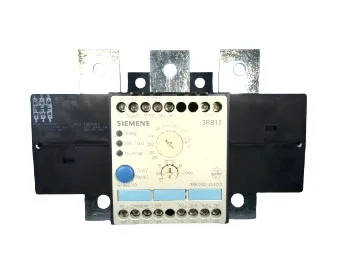
The 3RB1262-0LB11: The 200-820 A range covers large motor loads — think pumps, compressors, or conveyors drawing hundreds of amps. The adjustable trip class 5-30 lets you match the thermal curve to the motor's starting profile: class 10 for standard starts, class 20 for longer acceleration, class 30 for high-inertia loads. Class 30 means the relay allows up to 30 seconds of locked-rotor current before tripping — critical for applications like centrifuges or crushers where the motor takes time to spin up. The auxiliary circuit uses screw terminals for the control wiring; the main circuit connects via busbar. It supports manual, automatic, or remote reset — a feature that keeps a production line from restarting unexpectedly after a fault. The bistable outputs hold their state even if control power is lost, so the warning or trip condition is remembered. The overload warning output (DC 24 V) can feed a PLC or indicator lamp, giving early notice before a hard trip.
Deployment context
This relay mounts directly to the S10/S12 contactor or individually on a panel. For busbar connection, plan the main circuit layout with enough clearance for high-current busbars — this isn't a quick-fit terminal block. The screw-terminal aux circuit is straightforward for panel wiring. If you are retrofitting into an existing panel, verify the busbar pattern matches the S10/S12 footprint.