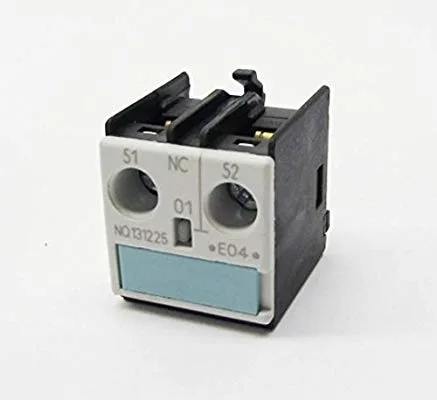
It adds two instantaneous N/O contacts to the base device, letting you pick up status feedback or extend control logic without extra wiring to a separate terminal block. Snap-on mounting means it clips directly onto the contactor's front face — no tools, no DIN-rail space consumed beyond the contactor itself.
What the current ratings mean on the line
This switch carries a voltage-dependent current table — a sign it's rated for both AC and DC control circuits. At 24 V it handles 6 A; at 230 V it handles 6 A (AC-12?); at 400 V it handles 3 A. The DC curve drops faster: 2 A at 48 V, 1 A at 110 V, 0.3 A at 220 V. For a motor-control center running 24 VDC pilot circuits, the 6 A rating is generous for a handful of PLC outputs or relay coils. At 400 VAC, the 3 A rating covers most contactor holding coils and indicator loads. The AC-12 maximum is 10 A, and the AC-15 rating at 690 V is 1 A — that's the electromagnetic-load curve for contactor coils at higher voltages. The mirror-contact feature per IEC 60947-4-1 (when paired with a 3RT1 contactor) means one N/O contact mechanically follows the main poles, giving a positive-break indication for safety circuits.
The block accepts 2 x (0.5 to 1.5 mm²) solid/stranded or 2 x (0.75 to 2.5 mm²) with ferruled ends — standard screw-clamp terminals. AWG equivalents are 2 x (20 to 16) and 2 x (18 to 14).