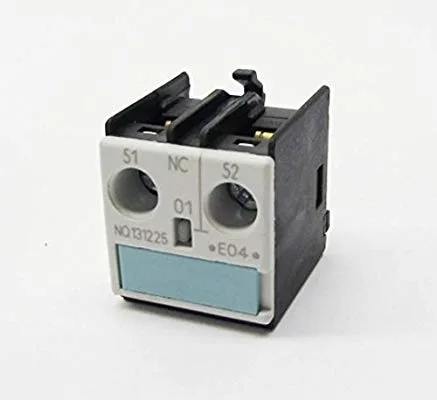
The Siemens SIRIUS 3RH1911-1GA22-ZX95 is a 4-pole auxiliary switch block designed for use with contactor relays and power contactors in the SIRIUS family. It provides 2 normally-open and 2 normally-closed instantaneous contacts arranged per EN 50011, wired via screw-type terminals. Rated for a maximum of 10 A, the block handles a range of control-circuit voltages: 6 A at 24 V, 6 A at 125 V, 6 A at 230 V, and 3 A at 400 V. For DC-13 type loads, it carries 10 A at 24 V, 4.7 A at 60 V, and 0.26 A at 600 V. That spread covers most pilot-duty and signal-level switching in a control panel. Contact reliability is specified at one faulty switching operation per 100 million cycles at 17 V, 5 mA — and a tighter spec of one per 100 million at 17 V, 1 mA for the auxiliary contacts. That means it handles low-energy signals from PLC outputs or relay logic without nuisance failures.
The block measures 36.5 mm wide, 41.5 mm deep, and 37.5 mm high — it clips directly onto the front of a SIRIUS contactor relay (3RH1 series) without taking additional panel width. Terminals accept two conductors per clamp: 2x (0.5 to 1.5 mm²) or 2x (0.75 to 2.5 mm²) with ferrule, or 2x (20 to 16 AWG) and 2x (18 to 14 AWG) solid. Surge voltage resistance is 6 kV, and insulation voltage is rated at 690 V with pollution degree 3 — adequate for 400 V line-to-line control circuits in industrial environments.
The 3RH1911-1GA22-ZX95 is a phased-out product. The manufacturer's official successor is the SIRIUS 3RH2 series auxiliary switch block. If you are holding a BOM line for this order code, the 3RH2 is the drop-in replacement path — verify the contact arrangement and terminal type match your panel wiring before reordering.