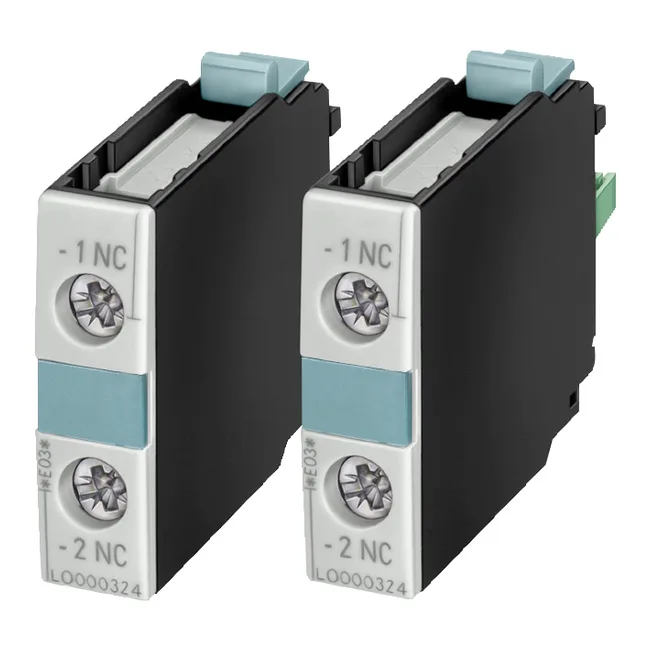
What this auxiliary switch does in the panel
It's the part you add when the main contactor needs to report its position back to the PLC, interlock a second device, or drive a panel light. The screw-type terminals accept 2x (0.5...1.5 mm²) solid or 2x (0.75...2.5 mm²) stranded, and the 10 mm width means it won't eat up DIN rail space the way a separate relay would. Rated at 10 A for AC-12 duty, the contacts handle typical control-circuit loads — PLC inputs, contactor coils, indicator lamps — without derating down to 24 V. The mirror contact feature per IEC 60947-4-1 (verified with 3RT1 contactors) means the N/O contacts cannot weld closed if the main contacts weld, a requirement for safety circuits that monitor contactor state.
Current ratings across the voltage range
The switching capacity varies significantly with applied voltage, which matters when you're mixing control voltages in the same panel. At 24 V the contacts are rated 6 A (with a 10 A rated value for the contact block itself), at 48 V and 60 V it drops to 2 A, at 110 V it's 1 A, at 230 V it's back to 6 A, and at 400 V it handles 3 A. The 230 V figure covers common single-phase control circuits in European panels; the 400 V rating covers line-voltage pilot devices in three-phase motor starters.
Mounting and integration with S0 contactors
Snap-on mounting directly to the contactor — no DIN rail required, no extra brackets. The 71 mm depth and 80 mm height match the S0 contactor envelope, so the assembly stays within the same panel footprint. Designed as a first laterally mountable block, it can sit on either side of the contactor, which helps when you need to stack multiple auxiliary blocks or a pneumatic timer alongside it.
RoHS compliance date is listed as July 1, 2006, covering the original EU directive. The part carries no explicit UL or CSA mark in the evidence, so verify with the factory if your site requires a listed component for the panel certification.