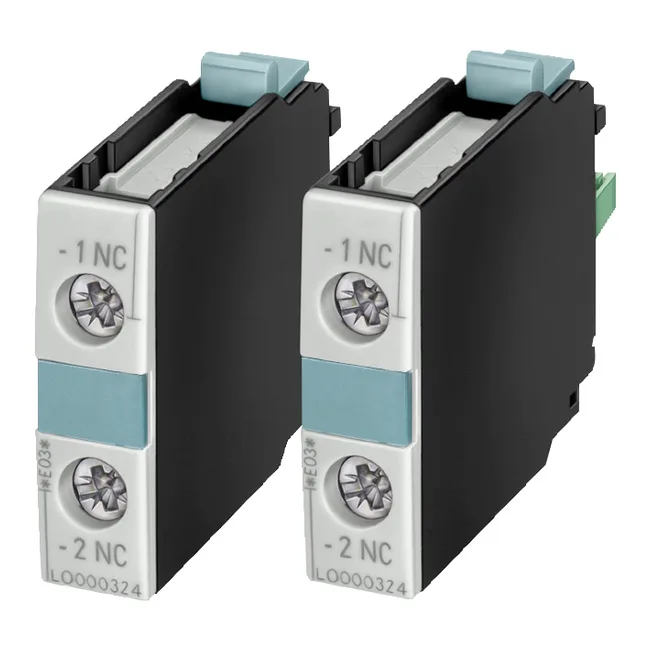
The Siemens SIRIUS 3RH1921-1HK22 is an attachable contact block designed specifically for 3RT1 contactors, providing four auxiliary poles in a 2NO+1NC+1NC configuration — the second NC contact is a lagging (after-position) pole. This is a screw-type terminal block, not a cage-clamp variant, so expect to terminate with a #1 Pozidriv bit. Rated for a maximum of 10 A, the contact ratings vary significantly by voltage and duty: at 24 V it switches 6 A (AC-15/DC-13), at 110 V it handles 1 A, at 230 V it carries 6 A, and at 400 V it drops to 3 A. The DC switching curve is steeper — at 24 V DC it's rated 10 A, at 60 V DC it's 4.7 A, at 220 V DC it's 1.2 A, and at 600 V DC it's 0.26 A. That means for a 24 V DC control circuit this block comfortably handles pilot-duty loads, but at higher DC voltages you need to respect the derating or risk welded contacts. The block snaps onto the front of a 3RT1 contactor — no tools, no DIN rail — and occupies the auxiliary contact bay. Dimensions are compact: 44 mm wide, 38 mm tall, 51 mm deep, fitting within the contactor envelope.
Contact reliability and service life
For low-level signal switching (17 V, 1 mA), the contact reliability specification is one faulty switching per 100 million operations, meaning this block can be trusted for PLC input sensing or safety circuit feedback without stutter. The insulation system is rated for 690 V AC at pollution degree 3, with a surge voltage withstand of 6 kV. That puts it in the standard industrial control panel class — fine for 400/480 V motor circuits with adequate clearance.
Snap-on mounting to the 3RT1 contactor front. The screw terminals accept 2x (0.5 to 1.5 mm²) or 2x (0.75 to 2.5 mm²) with core end processing, or 2x (20 to 16) and 2x (18 to 14) AWG. The lagging NC contact (the second NC pole, marked as after-position) is mechanically delayed relative to the main contactor operation — useful for interlocking or status feedback where you need the auxiliary to change state after the main contacts have opened or closed.