What it is and where it lands
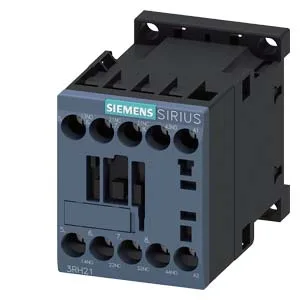
The Siemens 3RH2122-1AT60 is a SIRIUS auxiliary contactor — size S00 frame, with 2 normally-open instantaneous contacts rated 10 A at 24 V. It's the switching block that mirrors or extends the main contactor's state in a control circuit, not a power-handling device itself. Screw terminals and snap-on mounting onto 35 mm DIN rail mean it clips into the same panel rail as the main contactor, no extra bracket. The S00 footprint (45 mm wide, 73 mm deep, 57.5 mm tall) keeps the cabinet fill factor tight — you can stack several across a row without crowding the gland plate.
What the ratings mean for fit
The headline 10 A at 24 V is the thermal current through the auxiliary contacts in a DC control circuit — enough for a handful of PLC inputs or relay coils downstream. At 230 V AC it also carries 10 A; at 400 V AC it drops to 3 A. The 30 million mechanical cycles is the contactor's rated life without a load; under rated switching the electrical life will be lower but still well into millions, so it's not the wear item in a panel that sees a few cycles per minute. Surge voltage resistance at 6 kV means it withstands the transients common in industrial control panels without flashover. Operating temperature range -25 to +60 °C covers most indoor panel environments; storage range -55 to +80 °C handles shipping and warehouse extremes.
Mounting and integration
Mounts via screw and snap-on onto 35 mm DIN rail. The mounting position allows +/-180° rotation on a vertical surface and can be tilted forward/backward by +/-22.5° — useful when you're routing wires in a tight cabinet and need to orient the terminals toward the wireway. Clearance: 10 mm upwards, 10 mm forwards, 10 mm downwards, 6 mm at the side. That side clearance is the tight one — adjacent devices need that 6 mm gap for heat dissipation and tool access. Wire range: 2x (0.5...1.5 mm²), 2x (0.75...2.5 mm²), or 2x 4 mm² solid/stranded; AWG equivalents 2x (20...16), 2x (18...14), 2x 12. Degree of pollution 3 means it's rated for conductive dust and occasional condensation — typical for an unsealed panel in a factory environment.
