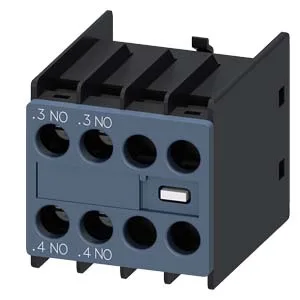
The Siemens 3RH2911-1HA20-ZW98 is a front-mounted auxiliary switch block from the SIRIUS family, designed to snap onto 3RT2 power contactors and 3RH2 contactor relays. It adds two normally-open (2 NO) instantaneous contacts — the kind you need for status feedback or enable signals in a motor control center. Rated for 10 A maximum and 690 V insulation class (degree of pollution 3), it carries a 6 kV surge withstand. That means it lives comfortably in the same panel as a 400 V drive or a 480 V motor branch — no extra coordination needed for the auxiliary circuit. Snap-on mounting and screw terminals for 2x (0.5 to 1.5 mm²) or 2x (0.75 to 2.5 mm²) solid/stranded — a wireman can land it in under a minute.
This block carries two sets of ratings: the maximum thermal current (10 A) and the AC-15 switching capacity at various voltages. The AC-15 rating at 690 V is 1 A — that's the inductive load capability for solenoid valves or contactor coils at line voltage. The 10 A figure is what you'd see on a resistive or lightly inductive auxiliary circuit at lower voltages. For DC switching, the voltage-specific ratings tell the story: 6 A at 24 V, 3 A at 110 V, 0.3 A at 220 V. If you're routing a 24 VDC sensor supply through these contacts, you've got headroom to 6 A per contact. At 220 VDC the current drops to 0.3 A — that's a real constraint for DC coil circuits at higher voltages. Mechanical life is 10 million switching cycles typical, and contact reliability is 1 faulty switching per 100 million operations at 17 V, 1 mA. That's the spec for low-level signal switching — it tells you the contacts are clean enough for PLC inputs without wetting current issues.