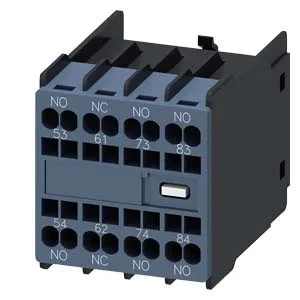
The Siemens 3RH2911-2XA31-0MA0-ZX95 is a front-mounted auxiliary switch block in the SIRIUS family, designed to snap onto 3RT2 power contactors and 3RH2 contactor relays. It provides 3 normally-open and 1 normally-closed auxiliary contacts, wired to terminals 53/54, 61/62, 73/74, and 83/84. The spring-loaded terminals accept 2x (0.5 to 1.5 mm²) with ferrules or 2x (0.5 to 2.5 mm²) solid, or 2x (20 to 14 AWG).
The contacts are rated 10 A maximum, but the real selection driver is the AC-15 rating at 690 V: 1 A. That's the inductive load rating for contactor coils and solenoid valves — the duty cycle that kills underspecified contacts. If you're switching a 24 VDC contactor coil, the 24 V rated value is 10 A; at 110 V it drops to 3 A, and at 220 V to 1.2 A. For DC-13 (solenoid) loads, the 24 V rating is 6 A, 60 V is 2 A, 110 V is 1 A, and 220 V is 0.3 A. If the signal chain involves a PLC input at low voltage, this block won't give you intermittent dropout from oxide films. That means it's suitable for direct mounting in the same panel as the power contactor without additional isolation barriers, even in environments with conductive dust or humidity (PD3). The IP20 front protection keeps fingers out but doesn't seal against washdown — this is a panel-interior part.
Snap-on mounting directly to the front of 3RT2 contactors or 3RH2 contactor relays. The block is 36 mm wide, 47.7 mm deep, and 41.5 mm high — it adds about 48 mm to the depth of the contactor. No tools needed for installation; it clips onto the contactor's front interface. The spring-loaded terminals face forward, so wiring is accessible with the contactor DIN-rail mounted.