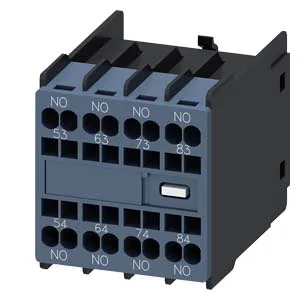
Four normally-open instantaneous contacts, labeled 53/54, 63/64, 73/74, 83/84. All four are independent current paths. The headline rating is 10 A maximum — that's the thermal current (Ith) carrying capacity. What matters for your specific control voltage is the switching capacity at that voltage: 6 A at 24 V, 6 A at 125 V, 6 A at 230 V, 3 A at 400 V, and 0.3 A at 220 V. For AC-15 inductive loads (solenoids, contactor coils) at 690 V, the rated value drops to 1 A — the 690 V insulation voltage with pollution degree 3 supports this, but the switching current is limited by arc extinction capability at that voltage. Mechanical service life is 10 million switching cycles typical.
Spring-loaded terminals for auxiliary and control circuits. Accepts 2x (0.5 to 1.5 mm²) with ferrule, or 2x (0.5 to 2.5 mm²) without ferrule. AWG equivalent is 2x (20 to 14). No screw torque to verify, no loose connections from vibration — spring-cage holds until you press the release. The 47.7 mm depth includes the terminal projection; the 36 mm width and 41.5 mm height match the contactor relay footprint.
Listed as current production stage. This part is actively manufactured by Siemens.
Environmental and protection class
IP20 on the front — protected against solid objects over 12.5 mm, no water protection. That's standard for inside a control cabinet.