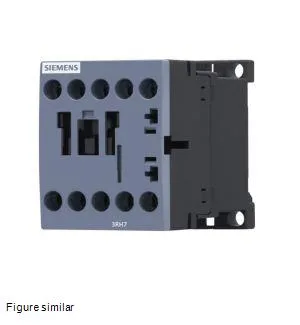
The Siemens SIRIUS 3RH7122-1AP00 is a size S00 contactor relay — essentially a pilot-duty switching block with 2 normally-open and 2 normally-closed auxiliary contacts (configuration 22 E). It's the signal-level interface between a PLC output or pushbutton and the main contactor coil, or it can switch small loads directly. The AC coil is wound for 230 V at both 50 Hz and 60 Hz, with a pickup draw of 27 VA and a holding draw of 5.4 VA. The screw-type terminals accept up to 2x 4 mm² solid or 2x 2.5 mm² stranded, which is generous for control wiring.
The auxiliary contacts are rated for 6 A at 24 V, 230 V, and 400 V AC, but only 1 A at 110 V and 690 V, and 0.3 A at 220 V. The 1 A at 690 V covers uncommon high-voltage control circuits. The contacts are also rated for DC-13 duty at up to 1 000 operations per hour, which covers solenoid loads with inductive kickback. A critical detail for PLC integration: the auxiliary contacts are specified for "acceptability for PLC control (17 V, 5 mA)" — meaning the silver-alloy contacts reliably switch dry logic-level signals without needing gold plating or a separate interface relay. This saves a component and a wiring step when feeding back status to a 24 V DC input card. In practice, this means the relay can survive switching transients on a 400 V line without flashover — important for long cable runs in industrial environments.
Dimensions are 45 mm wide, 57.5 mm tall, and 72 mm deep — the width is the critical number for DIN-rail budgeting: it occupies one standard 45 mm module. Operating temperature range is -10 to +55 °C, storage from -25 to +70 °C. Shock resistance is 15g for 5 ms (sine pulse) and 10g for 5 ms (rectangular pulse), which is adequate for most machine-mounted panels but not for direct mounting on a vibrating press. Maximum installation altitude is 2 000 m above sea level — standard for most industrial sites. Above that, derate the switching capacity per IEC 60947.
There's no need to stockpile or search surplus channels.