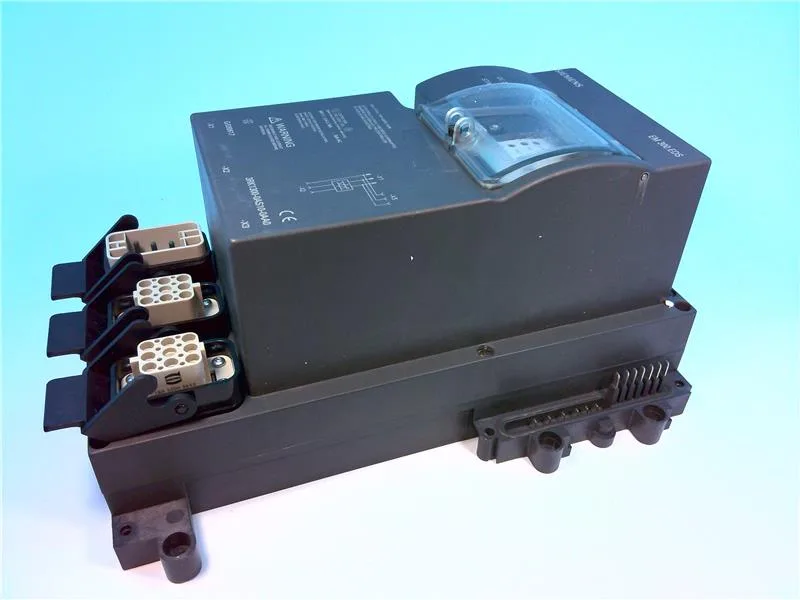
What this reversing starter does on a motor branch
The Siemens 3RK1300-0HS01-1AA3 is an electromechanical reversing starter from the SIRIUS EM 300 RS family, designed to control and protect a small three-phase motor in applications that require forward/reverse operation — conveyors, hoists, gate drives, or any reversing load on a 400 V line. The bimetal overload relay covers a setting range of 0.55 to 0.8 A, so it is sized for a motor drawing that full-load current — verify the motor nameplate FLA falls within that window before committing the BOM line. No separate enclosure needed for the starter itself. PROFIBUS DP is built in, so the starter communicates directly with a PLC or higher-level controller over the fieldbus without an extra gateway module. The integrated motor brake output (product component Motor brake output = Yes) handles an internally supplied DC brake, saving a separate brake contactor.
Dimensions: 270 mm high x 140 mm wide x 134 mm deep. The main current circuit connects via tab terminals — expect blade-type receptacles, not screw clamps. The 9-pole motor feeder and 9-pole power connection are part of the assembly, so the wiring plan should account for those multi-pin interfaces rather than individual lug terminations. The unit carries equipment marking Q per DIN EN 61346-2, which classifies it as a power switching device in the panel schematic.
Short-circuit protection and breaking capacity
Short-circuit protection is designed around circuit-breakers (not fuses) per the product design. The maximum short-circuit breaking capacity (Icu) at 400 V is 50 A — this is the fault current the starter can safely interrupt without damage upstream. For a panel with a higher available fault current, the upstream breaker or fuse must limit the let-through to 50 A or less.