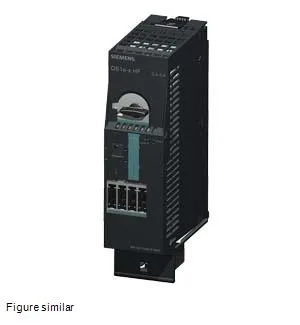
What this SIMATIC motor starter gives you
The Siemens SIMATIC 3RK1301-0AB10-0AA4 is a direct motor starter — meaning it handles full-voltage starting for three-phase motors without reversing. It's part of the SIMATIC motor starter family, designed to integrate into PROFINET networks so you get diagnostics and control right over the fieldbus. The adjustable trip class is the feature to pay attention to here: you can set it to CLASS 10 or CLASS 20. CLASS 10 trips faster (within 10 seconds at locked-rotor current), which protects motors with shorter thermal time constants — think pumps or fans that don't tolerate prolonged stall. CLASS 20 gives you more headroom for high-inertia loads like conveyors or crushers that need a longer acceleration ramp. That adjustability means one part number covers both scenarios, so you're not stocking two separate overload relays. It's certified to IEC 60664 and IEC 61131 with a pollution degree of 3 at 400 V, meaning it's rated for the dusty, conductive environment you'd expect in a real factory floor panel.
This starter mounts by plugging onto a terminal module — no DIN-rail clips, no screw-down feet. The terminal module is the base that carries the power wiring; the starter module itself snaps onto it. That means you can pre-wire the terminal module during panel build, then plug the starter in after the panel is powered down for commissioning. It's a clean separation of power and control wiring. Physical envelope: 65 mm wide, 290 mm high, 150 mm deep. That 65 mm width is a single unit width — it fits in a standard 600 mm wide enclosure with room for nine more starters side by side. The 290 mm height is tall enough that you'll want to check your enclosure's internal backplate clearance, especially if you're mounting a busbar system above it. Mounting position is flexible: vertical or horizontal. If you're tight on vertical space in a shallow panel, horizontal mounting works, but keep in mind that the terminal module's screw-type terminals for the main power infeed need tool access from the front.
The starter has 2 digital inputs wired through the control module. I/O mapping is 2 bytes for inputs and 2 bytes for outputs over PROFINET. Supply voltage is 24 V DC nominal, with a tolerance of 20.4 V to 28.8 V. Maximum permissible voltage is 28.8 V. PROFINET is the primary fieldbus, but it also supports PROFIBUS DP — both protocols are listed. If your plant runs a mixed network with some lines on PROFIBUS and others on PROFINET, this starter can handle either, but you'll need the correct control module variant for the bus type.
Environmental limits and mechanicals
Operating temperature range is 0 to 60 °C — that's typical for an IP20 panel-mounted device. Vibration resistance is 2g continuous; shock resistance is 5g for 11 ms. That's enough for most industrial environments but not for direct mounting on a vibrating machine frame — if you're mounting it on a press or a large compressor, you'll want to isolate the panel. Maximum operating frequency is 750 operations per hour. Power dissipation with bypass circuit is 5.6736 W; without bypass it is 5.674 W.