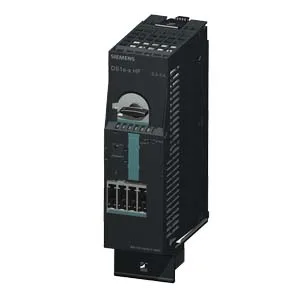
The 3RK1301-0BB13-0AA2 is a Siemens SIMATIC-branded motor starter in a direct-start configuration, designed to plug onto a terminal module in an ET 200pro remote I/O station. It integrates the motor protection relay, contactor function, and fieldbus interface into one package that mounts vertically or horizontally on the DIN-rail assembly. Rated supply is 24 V DC nominal with a permissible range of 20.4 V to 28.8 V — the control power must stay inside that window or the internal electronics drop out. The 50 kA rated short-circuit current at 400 V means this starter can be placed downstream of a feeder capable of delivering that fault level without the device rupturing, provided the upstream protective device is coordinated. Trip class is adjustable between CLASS 10 and CLASS 20, which sets the thermal overload trip time for motor starting. CLASS 10 suits fast-starting loads like pumps and fans where the rotor locks quickly; CLASS 20 gives more headroom for high-inertia loads like centrifuges or conveyors that take longer to accelerate. The 80 1/h maximum operating frequency limits how often the starter can cycle — above that the thermal memory accumulates and nuisance trips become likely.
Fieldbus and I/O mapping — PROFINET and PROFIBUS DP with 2-byte process data
This starter speaks both PROFINET and PROFIBUS DP, so it drops into either a PN or DP line without a gateway. The process data image is 2 bytes of inputs and 2 bytes of outputs — the input word carries the status bits (running, overload trip, fault), and the output word carries the start/stop command and reset. Two digital inputs are available on the control module for local feedback or permissive signals; they sink 24 V DC and are mapped into the input byte. The safe state is defined as load circuit open, meaning on loss of communication or a fieldbus watchdog timeout the starter drops the motor contactor and the load is de-energised. This is the expected behaviour for a fail-safe zone — the downstream machine stops on any bus fault, which holds the unit on the grid in a controlled stop rather than a free-run coast.
Reliability and environmental endurance — MTBF, MTTFd, shock, and vibration
The listed MTBF is 14 years and the MTTFd is 31 years — these figures come from the component-level reliability prediction per IEC 61709. For a safety loop requiring SIL 2 or PL d, the MTTFd of 31 years places this starter in the 'high' category per EN 13849-1, provided the rest of the safety chain (sensor, logic, actuator) is similarly rated. The 5g shock resistance at 11 ms and 2g vibration resistance mean it survives on a machine frame or conveyor section without the terminal connections fretting open. Pollution degree is 3 at 400 V and 2 at 500 V per IEC 60664 — this means the device is rated for conductive pollution environments (condensation, light dust) up to 400 V, but above that the creepage distances assume a cleaner atmosphere. In a typical panel with an IP54 enclosure, pollution degree 3 is the normal assumption.