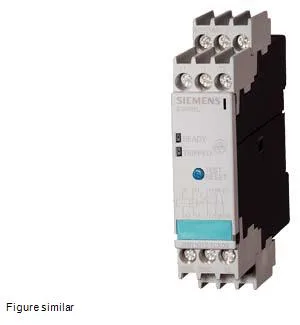
The Siemens 3RN1012-1GB00 is a thermistor motor protection evaluation unit from the SIRIUS 3RN1 series. It monitors PTC thermistor sensors embedded in motor windings and trips the control circuit when the winding temperature exceeds the sensor's rated response threshold. The unit operates on 24 V AC/DC supply and provides two changeover (CO) contacts for signaling and lockout. The two CO contacts give you one normally-open and one normally-closed path per contact, suitable for wiring a trip alarm to a PLC input and a separate latching circuit to the contactor coil. The part includes a reclosing lockout function, meaning after a thermal trip the unit will not automatically reset when the motor cools — it requires a manual reset or a remote reset signal to re-energize the contactor. This prevents unexpected motor restarts on a manned line.
Lifecycle status and sourcing reality
The 3RN1012-1GB00 is a phased-out product. The preferred successor is the 3RN2012-1BA30, a thermistor motor protection standard evaluation unit with manual/auto/remote selection and hard gold-plated contacts rated for 24 V AC/DC. The successor 3RN2012-1BA30 offers the same basic function but adds operating mode selection; verify the wiring and panel cutout compatibility before substituting, as the form factor and terminal layout may differ.
Its 22.5 mm width is a single modular unit, fitting standard control panel spacing. Depth is 91 mm, height 102 mm. Protection class is IP20 — suitable for installation inside a closed control cabinet.